
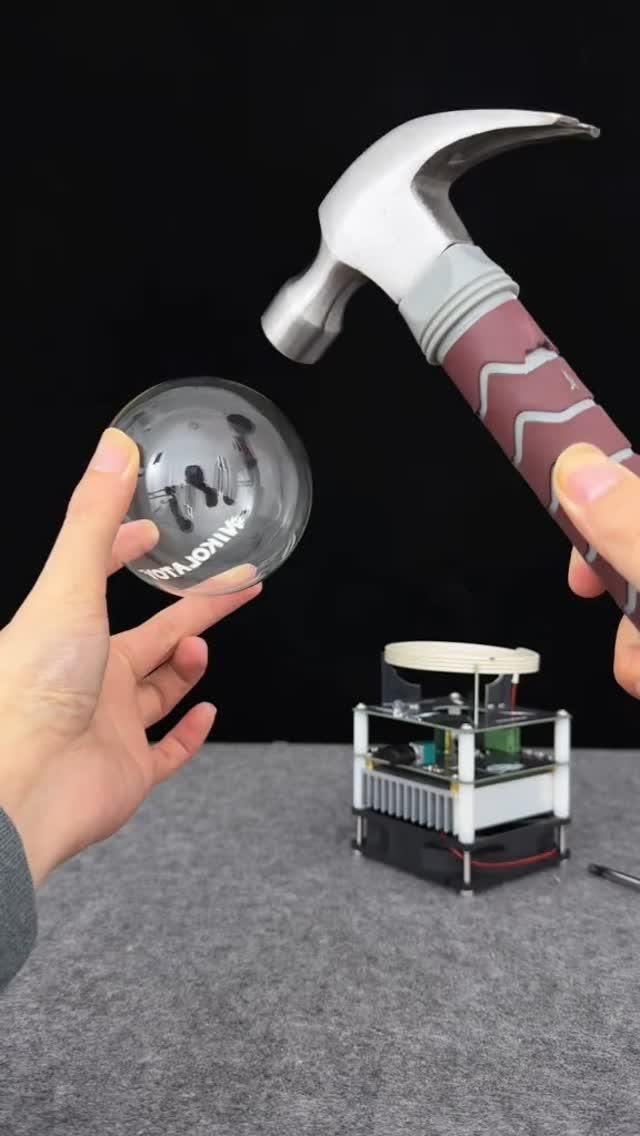
A floating toroidal plasma ring that looks more like a controlled physics experiment than a standard plasma globe
This is a xenon glass sphere plasma display driven by an external induction coil, designed to create a bright circular ring of ionized gas instead of the branching lightning filaments most people expect from novelty plasma balls. The result is a compact desktop showpiece that feels half science demo, half futuristic decor object, with its exposed driver electronics, cooling hardware, and visible coil making the engineering part of the appeal.
The Standout Appeal & Why It Caught Our Attention
What makes this piece unusual is its electrode-free toroidal plasma effect. Rather than firing chaotic arcs from a center electrode, it uses a tuned high-frequency field to sustain a stable glowing ring inside the bulb. Visually, that gives it a much cleaner and more deliberate look—closer to a miniature particle experiment or a tiny artificial black hole effect than a toy-store plasma globe.
- More controlled visual effect: the plasma forms a defined halo-like ring instead of random tendrils.
- Exposed lab-style construction: the open-frame base, visible circuit boards, and heatsink make it feel like a real experimental device rather than sealed decor.
- Strong desk presence: even when off, the clear sphere and equatorial coil give it a sculptural, conversation-starting look.
Key Features & How It Works
The system centers on a sealed xenon-filled glass bulb placed within an external ring coil mounted around the sphere’s equator. A solid-state high-frequency driver energizes that coil wirelessly, inducing the gas discharge inside the bulb. Because the excitation geometry is circular, the ionized gas appears as a bright torus suspended within the globe.
- Xenon gas sphere: the clear glass bulb produces an intense icy white-blue to violet glow when ionized.
- Induction ring coil: the pale wire coil wrapped around the middle of the sphere is the key to the floating ring effect.
- Open driver platform: stacked circuit boards, standoffs, and exposed components suggest a resonant high-frequency oscillator design.
- Large aluminum heatsink: the finned metal block on the lower section helps dissipate heat from the power electronics.
- Bottom cooling fan: active airflow supports short high-output runs and helps stabilize the compact circuit assembly.
- Manual control interface: the visible knob/switch area and status LED indicate direct power control rather than app-based operation.
The images also show that the sphere can be lifted or repositioned, and the plasma behavior changes with placement and touch proximity, which adds to its appeal as a hands-on demonstration object.
Practical Everyday Uses
This is not a utility lamp in the traditional sense; its value comes from visual impact, STEM curiosity, and desktop atmosphere.
- Desk centerpiece for makers and tech enthusiasts: ideal for a workshop, PC setup, or studio where exposed electronics and unusual light effects fit the environment.
- Physics demo object: useful for showing induction, ionization, resonance, and gas discharge concepts in a much more memorable way than static diagrams.
- Conversation-starting decor: a strong fit for shelves, creator backgrounds, or display cabinets where unusual kinetic-light objects stand out on camera.
Things To Consider Before Buying
This is a specialized high-voltage display piece, so it deserves more care than ordinary desk decor.
- Heat output matters: the glass near the coil and the aluminum heatsink can get hot during operation.
- Best used in short sessions: compact high-frequency electronics generate significant thermal load, so this is better as an intermittent display than an all-day light.
- Open electronics require caution: avoid touching exposed circuit elements or coil areas while powered.
- Fragility: the glass sphere is the visual centerpiece and the most delicate part of the system.
- Ambient use case: this is primarily a display and demonstration object, not a room-lighting solution.
- Power and placement: give it a stable surface, ventilation space, and keep it away from clutter that could block the fan or cooling fins.
For the right buyer, this is less about everyday convenience and more about owning a compact electromagnetic plasma sculpture that visibly shows off the physics happening inside it.