
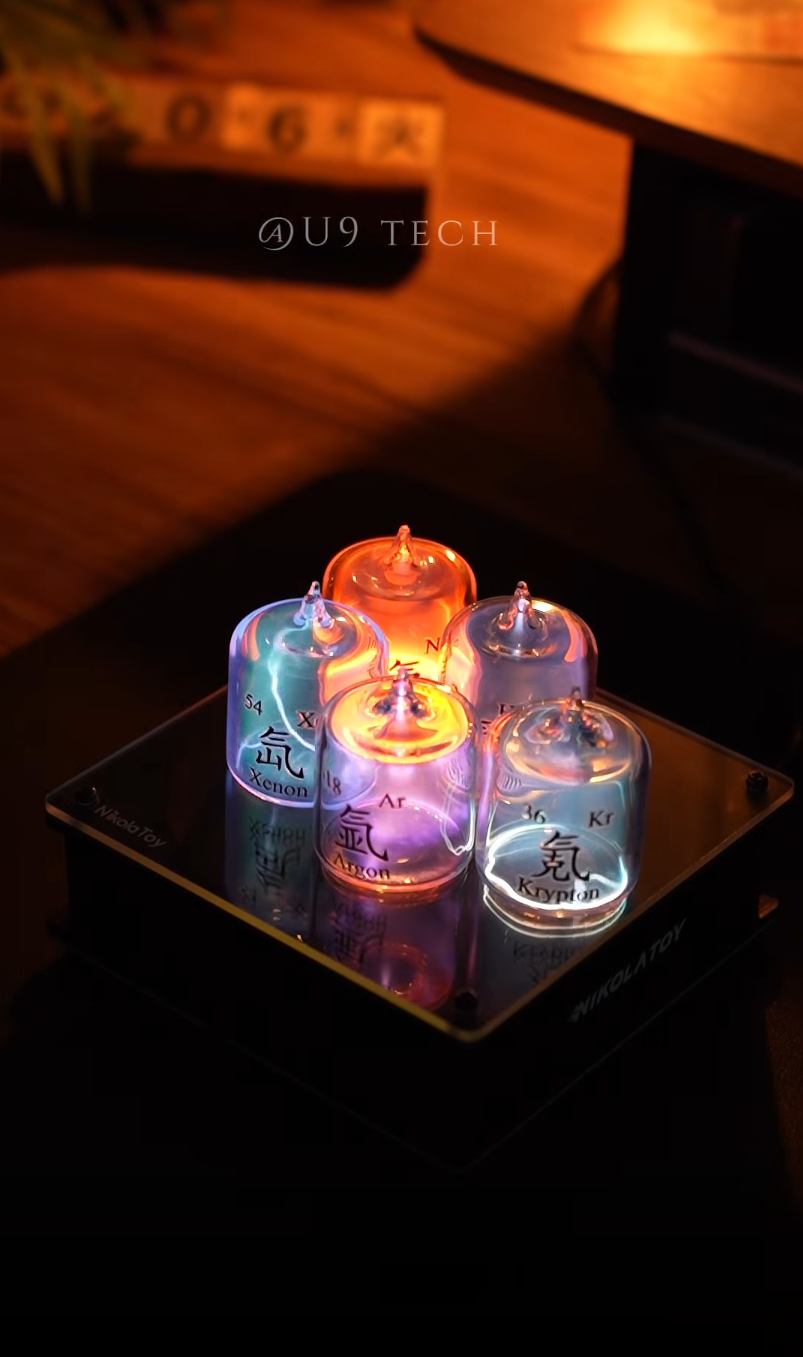
A desktop plasma display that turns rare gases into visible, touch-reactive light
This is the kind of science decor that does more than sit on a shelf. The NikolaToy set pairs sealed noble-gas glass vessels with an electronic excitation base, letting each element reveal its own signature glow color through ionization. In the cup-style format shown here, the effect becomes even more dramatic: you get both the pure gas glow of the inner vial and lightning-like plasma arcs moving around the outer glass when the field is active.
The Standout Appeal & Why It Caught Our Attention
Most desk lighting products simulate a science-lab look. This one uses the actual physical behavior of rare noble gases under a wireless high-voltage excitation field. That means the color is not arbitrary RGB decoration; it is tied to each gas element’s atomic emission spectrum. Neon burns with a vivid orange-red, helium appears pale white-yellow, argon leans purple, and gases like krypton or xenon can shift toward cool blue-green tones.
What makes this version especially compelling is the lightning cup architecture. Instead of a standard straight tube that glows uniformly, these double-walled glass forms create moving plasma paths that crawl along the outer vessel and respond to nearby touch. It lands somewhere between physics demonstrator, kinetic light sculpture, and collector-grade desk ornament.
Key Features & How It Works
The system uses a powered base and multiple sealed gas-filled glass vessels. From the visuals, the base appears to be a compact black excitation platform with a reflective top plate, designed to energize one or more vessels placed directly on its surface.
- Wireless excitation base: Generates a strong high-voltage field that energizes the gas without exposed wiring inside each cup.
- Sealed borosilicate-style glass vessels: The gases are permanently enclosed, which is why the set can be handled as a display object rather than lab equipment.
- Distinct gas labeling: The pictured set shows elements such as Neon, Helium, Argon, Krypton, and Xenon, each marked on the glass.
- Two-layer visual effect: The inner gas vial emits its characteristic glow while the outer cup can show branching or traveling plasma arcs.
- Touch interaction: Finger proximity influences the electric field, causing arcs to bend or concentrate toward the touch point on the outer glass.
- Reflective display platform: The mirrored top amplifies the glow and makes the color differences between gases more obvious in dim rooms.
In practical terms, the base energizes the sealed gas atoms until they enter a glowing plasma state. As those atoms return to lower energy levels, they release light at specific wavelengths. That is why each element produces a recognizable color instead of a random one.
Practical Everyday Uses
This is a niche object, but it has surprisingly clear use cases beyond simple decoration.
- Desk centerpiece for science and tech enthusiasts: On a home office desk, maker bench, or gaming setup, it works as a conversation-starting ambient display that feels more intelligent than a standard LED lamp.
- STEM teaching aid: Teachers, tutors, and parents can use it to introduce concepts like ionization, plasma, noble gases, and emission spectra in a way that is instantly visible.
- Giftable collector display: It suits physics lovers, chemistry students, museum-shop shoppers, and anyone who appreciates interactive objects with a genuine scientific basis.
Things To Consider Before Buying
Before ordering one of these sets, it helps to know what type of experience you want.
- Choose the format carefully: Standard tube sets are usually less expensive and produce a more even column glow. The lightning cup version is more dramatic and interactive, but it also tends to cost more.
- Use it as display tech, not drinkware: Despite the cup-like shape, these are sealed glass plasma vessels and should be treated as delicate electronic display pieces.
- Check power requirements: Excitation bases may use wall power, USB power, or proprietary adapters depending on the seller.
- Handle with care: The vessels are glass and should be kept away from edges, children, and crowded shelves where they could be knocked over.
- Expect best results in low light: The glow is visible in normal rooms, but the color separation and plasma effect look much stronger in dim or evening environments.
If you want a science object that is both visually unusual and grounded in real physics, this style of noble gas glow set is far more interesting than ordinary mood lighting.