
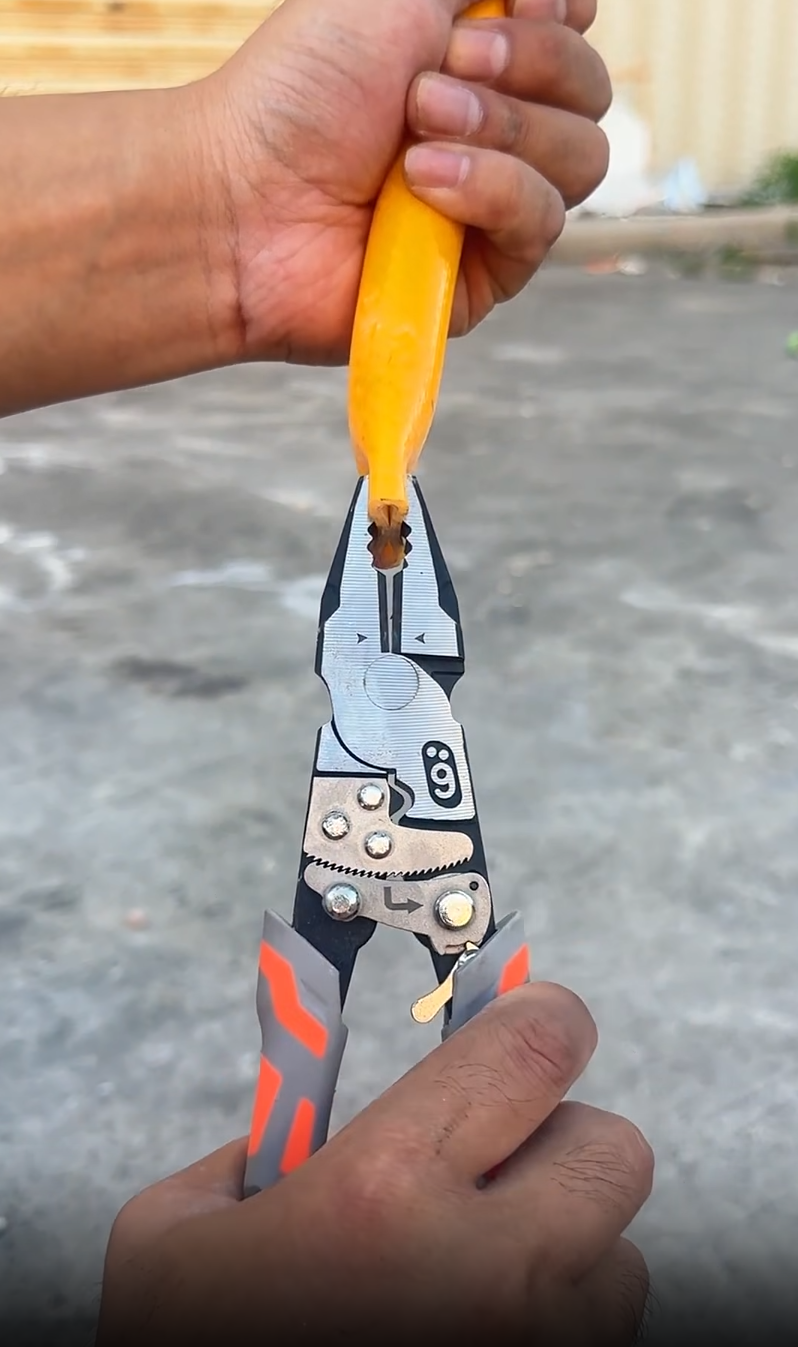
A locking plier that keeps squeezing for you
These 9-inch ratchet self-locking grip pliers solve one of the most annoying limitations of ordinary pliers: the moment your hand relaxes, the grip disappears. Here, a built-in ratcheting mechanism lets the jaws clamp down in stages and stay locked after you let go, turning the tool into a compact mechanical third hand for pulling, holding, twisting, and stabilizing awkward parts.
The Standout Appeal & Why It Caught Our Attention
What makes this tool interesting is not just that it grips hard, but that it stores clamping force mechanically. Instead of relying on constant hand pressure, the ratchet accumulates tension as you squeeze. That changes how the tool behaves in real work: you can lock onto a nail, wire, pin, sheet edge, or small part and then use your free hand for a drill, screwdriver, fastener, or alignment.
- More control than standard pliers: the jaws hold position without continuous effort.
- Faster than a vise for quick tasks: useful when you need temporary holding power, not a full bench setup.
- Especially handy for awkward angles: the images show it gripping board edges and hardware where normal pliers would slip once hand pressure changes.
Key Features & How It Works
The tool shown matches the common Amazon-style 9” Grip Pliers with Ratchet Self-Locking design, with a forged metal body, exposed ratchet gear, and quick-release lever integrated into the handle area.
- Self-locking ratchet system: each squeeze advances the mechanism, tightening the jaws incrementally until the desired grip pressure is reached.
- Quick-release lever: a small release tab disengages the lock instantly so the jaws spring open without fighting the mechanism.
- Serrated gripping jaws: the nose has stepped, aggressive teeth for holding nails, wire, pins, and irregular hardware more securely than smooth-jaw pliers.
- 4-in-1 multifunction layout: seller listings commonly describe this style as combining gripping jaws, wire stripping/cutting sections, crimping area, and small wrench-style cutouts for nuts or bolt heads.
- Long ergonomic handles: the gray-and-orange anti-slip grips add leverage and make repeated squeezing less fatiguing.
- Heavy-duty steel construction: typically listed in 55# carbon steel or CR-V steel, chosen to resist jaw deformation under load.
- Approximate size: 9 inches overall, large enough for meaningful leverage but still compact enough for a tool bag or drawer.
In the images, the pliers are shown pulling embedded nails, clamping onto a board edge, and even supporting body weight while locked onto a pallet edge. That last demo is obviously extreme, but it does illustrate the core point: the ratchet is designed to maintain pressure after engagement.
Practical Everyday Uses
This is the kind of tool that becomes valuable when a job would normally require two hands, a helper, or repeated re-gripping.
- Electrical and wiring work: grip and twist wire, strip or cut conductors, hold small terminals steady, or crimp connectors while keeping one hand free.
- Home repair and woodworking: pull stubborn nails or pins, clamp onto thin board edges, hold brackets in place, or stabilize small hardware during assembly.
- Automotive and garage tasks: grab clips, cotter pins, cable ends, or rounded small parts in tight spaces where ordinary pliers tend to slip.
Things To Consider Before Buying
Like many viral tools sold under multiple third-party listings, this one is worth checking carefully before ordering.
- Brand consistency varies: many versions are generic, so steel type, finish quality, and jaw alignment may differ from seller to seller.
- It is not a replacement for every plier: the ratchet mechanism is excellent for locking grip, but for delicate electronics or ultra-fine work, standard precision pliers may still be better.
- Check the jaw geometry: make sure the nose shape and integrated functions match your actual tasks, especially if you want stripping, crimping, or nut-gripping features.
- Expect a small learning curve: using the ratchet efficiently takes a few tries, particularly when setting the right pressure and releasing quickly.
- Size matters: at 9 inches, it offers leverage, but it may be bulkier than compact pliers for very confined spaces.
If your projects often involve holding something stubborn while your other hand does the real work, this design makes a strong case for itself. It is less about replacing every plier in the toolbox and more about adding a locking, one-handed helper that standard pliers simply are not.