
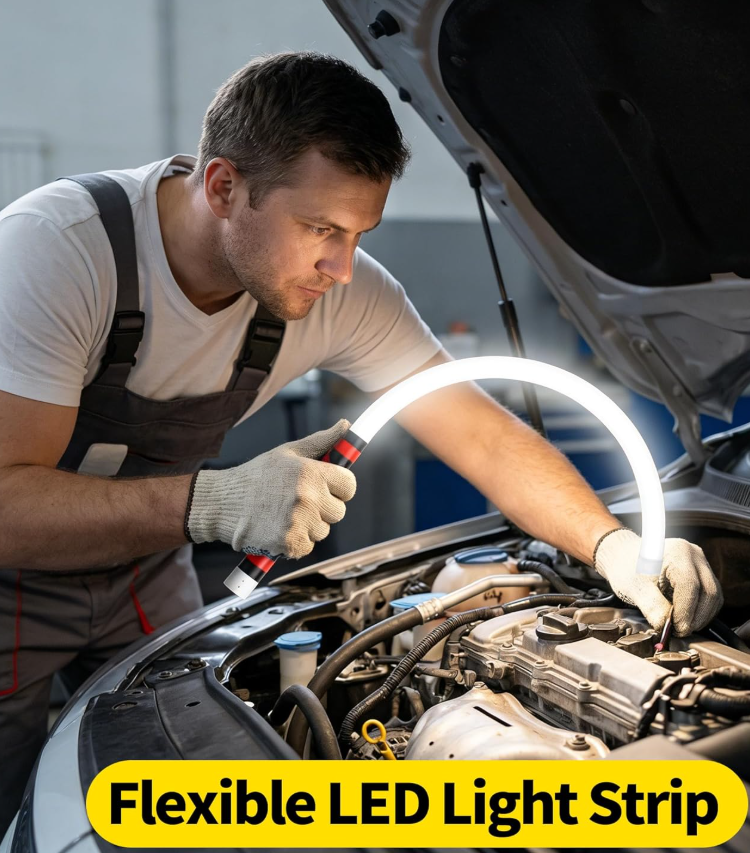
A bendable mechanic’s light that can snake into engine bays and stay aimed where ordinary flashlights fail
This flexible rechargeable LED work light is built for one of the most annoying shop problems: getting bright, even illumination into cramped spaces without having to hold a flashlight in one hand the entire time. Instead of a rigid beam coming from a fixed head, the illuminated stick itself bends and curves around hoses, covers, brackets, and wiring so light lands exactly where the repair is happening.
The Standout Appeal & Why It Caught Our Attention
Most work lights either flood a whole area from too far away or create a narrow hotspot that still leaves shadows behind engine components. This design takes a smarter route. The entire flexible light section glows, letting the user shape the beam path physically rather than just tilting a lamp head. That makes it especially compelling for mechanics, DIY car owners, and anyone working in tight service spaces where visibility is blocked by surrounding parts.
- Bend-first lighting design helps the light wrap around obstacles instead of shining past them.
- Hands-on control from a flashlight-style handle makes it easy to reposition quickly while diagnosing or repairing.
- Wide-area illumination reduces harsh shadows compared with a small point-source torch.
Key Features & How It Works
From the visuals and provided context, this is a rechargeable flexible LED flashlight stick with a black-and-red handheld grip and a long white illuminated body. The light tube appears to be built around a semi-rigid internal structure that holds its shape after bending, allowing it to act almost like a poseable task light.
- Flexible illuminated shaft: The glowing section can be curved into arcs or hooked shapes to direct light deeper into engine compartments.
- Rechargeable power system: Designed to be reused rather than fed by disposable batteries, which is more practical for garage work.
- Multiple brightness modes: These lights commonly offer more than one output level, useful for balancing runtime and glare.
- Extended reach: User-provided context suggests typical lengths between 28 and 44 inches, which is long enough to reach behind radiators, under intake plumbing, or along firewall areas.
- Ergonomic handle: The thicker grip gives better control when feeding the light into narrow spaces and pulling it back out.
- Diffuse LED output: The glowing tube creates a broader wash of light than a standard inspection flashlight, making labels, bolts, connectors, and fluid lines easier to see.
Practical Everyday Uses
This is the kind of tool that becomes surprisingly useful once you’ve worked with it in a few awkward spaces.
- Engine bay repairs: Ideal for tracing belts, checking alternator connections, finding leaks, or illuminating the back side of the engine where overhead shop lights don’t reach.
- Garage and under-hood maintenance: Helpful for oil changes, spark plug access, battery work, fuse checks, and brake fluid inspections during evening or indoor work.
- General tight-space lighting: Also useful for HVAC compartments, utility closets, crawlspaces, behind appliances, or inside cabinets where a rigid lantern is too bulky.
Things To Consider Before Buying
Before choosing one, it’s worth checking a few practical details that affect real-world usability.
- Length matters: A longer model reaches deeper into engine bays, but a shorter one may be easier to control in compact cars.
- Battery runtime: Higher brightness is useful, but verify how long it lasts per charge if you do extended repair sessions.
- Charging port and cable type: USB-C is more convenient than older connectors if you recharge tools often.
- Heat and shop durability: Make sure the outer tube and handle are suited for dirty, oily environments and occasional contact with warm components.
- Shape retention: The best versions hold a bend firmly without drooping, which is crucial for true hands-free positioning.
For mechanics and serious DIYers, this is a clever upgrade over a conventional flashlight because it doesn’t just brighten the workspace—it adapts to the shape of the workspace.