
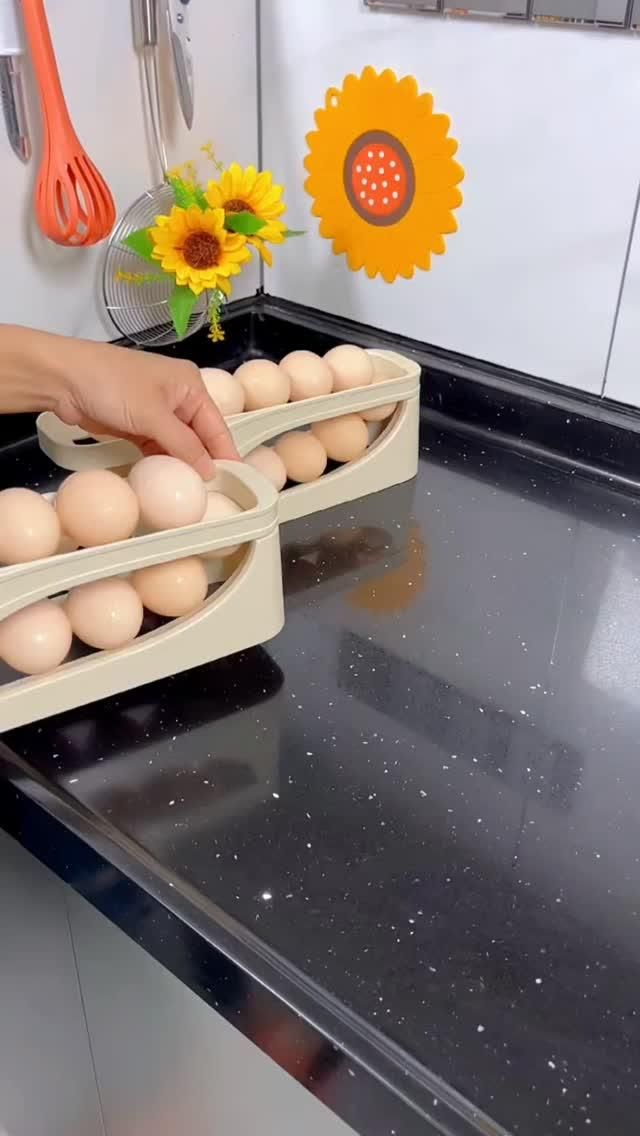
A gravity-fed egg organizer that automatically rolls the next egg forward
This compact double-layer egg rack holder is designed to solve one of the most common refrigerator annoyances: loose cartons, wasted shelf space, and eggs getting buried in the back. Instead of stacking eggs in a box or bowl, this holder uses a sloped rolling track so each egg gently advances to the front as one is removed, keeping the oldest eggs easiest to reach.
The Standout Appeal & Why It Caught Our Attention
What makes this organizer interesting is how much function it gets from a very simple physical design. There are no motors or electronics here despite the “automatic” effect. The rack relies on gravity, angled rails, and open side supports to create a continuous first-in-first-out flow. That means better visibility, easier access, and less rummaging through a carton with wet or messy hands while cooking.
- Space-efficient footprint: built vertically in two tiers rather than spreading eggs across a wide tray.
- Front-dispense layout: eggs collect at the lower front opening for quick one-handed pickup.
- Open-frame visibility: you can instantly see how many eggs are left without opening a carton.
Key Features & How It Works
The holder shown appears to be made from a smooth molded plastic in a neutral cream/beige finish, with rounded edges that are easier to wipe clean and less likely to chip eggs on contact. Its structure uses an upper loading lane and a lower dispensing lane connected by a curved side channel.
- Double-layer track system: eggs are loaded from the top and roll down through the internal curved path as space opens below.
- Gravity-fed dispensing: removing one egg from the front allows the next egg to roll into position automatically.
- Protective side walls: the raised rails help keep eggs aligned and reduce accidental rolling off the shelf.
- Compact refrigerator fit: the narrow rectangular shape is designed to sit neatly on a fridge shelf or countertop corner.
- Modular form: the images suggest it can be used as a single unit or placed alongside another for higher capacity.
The overall engineering is clever because it improves egg rotation naturally. Older eggs are typically dispensed first, which is more practical than repeatedly opening a carton and grabbing from random positions.
Practical Everyday Uses
This is the kind of organizer that becomes most useful in kitchens where eggs are used constantly and fridge space matters.
- Busy home cooks: if you cook breakfast daily or bake often, the front-access design makes grabbing one or two eggs much faster than handling a full carton.
- Small refrigerators: apartment kitchens and shared homes benefit from the upright, tidy layout that frees shelf width for other groceries.
- Bulk egg buyers: households that buy larger quantities can use multiple racks side by side to keep eggs visible, organized, and easier to rotate.
Things To Consider Before Buying
Before ordering, it is worth checking a few practical details to make sure the rack suits your kitchen setup.
- Measure shelf depth and height: the sloped two-tier design is compact, but it still needs enough clearance in the fridge.
- Check egg size compatibility: very large or unusually shaped eggs may roll differently than standard eggs.
- Use on a stable, level surface: the rack depends on its built-in slope, so it works best when the shelf itself is not warped or heavily tilted.
- Capacity varies by model: visually, this style appears suited for a moderate household supply rather than extra-large commercial storage.
- Plastic construction: lightweight and easy to clean, but buyers who prefer sealed storage should note this is an open organizer rather than a lidded container.