
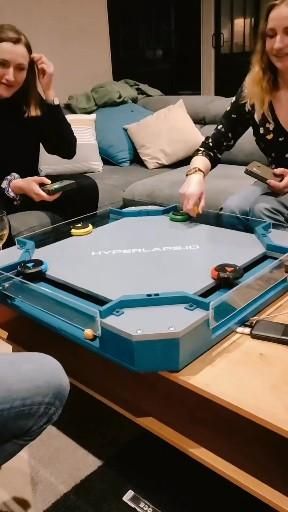
A living-room arcade board that turns Pong-style reflex battles into a physical 4-player tabletop game
Hyperlaps Initial is one of those rare DIY-born creations that immediately makes sense the moment you see it in action: four players, four wireless controllers, one fast-moving ball, and a compact arena that feels like a mashup of air hockey, Pong, and a miniature robot sport. Instead of tapping a screen, each player controls a motorized bumper that slides along their edge of the board, creating a much more tactile and social kind of competition.
The Standout Appeal & Why It Caught Our Attention
What makes Hyperlaps so compelling is that it translates a familiar digital game loop into a real mechanical object. The board is not just decorative or novelty tech; it creates visible motion, physical impacts, and immediate couch-friendly multiplayer chaos. The octagonal arena, transparent side walls, colored player bumpers, and controller-based movement all give it the feel of a custom arcade machine shrunk down for a coffee table.
- Physicalized arcade gameplay: It delivers the speed and simplicity of Pong, but with actual moving parts and real ball collisions.
- Four-player design: Most tabletop skill games are one-on-one. Hyperlaps is built around group play, which makes it much better for parties and casual gatherings.
- DIY engineering appeal: The original version from hyperlaps.io is especially interesting because it is also a maker project, with blueprints, 3D files, electronics guidance, and parts lists for people who want to build the machine themselves.
Key Features & How It Works
The board uses a motorized bumper system on each side of the arena. Every player holds a compact wireless Bluetooth gamepad with a joystick and button. The joystick moves that player’s bumper left and right along a track, while the action button triggers a front-facing mechanical strike to smack the ball back into play.
- 4 independent player stations: Each side has its own sliding bumper ship, color-coded for quick recognition during fast matches.
- Wireless Bluetooth controllers: Players are not tethered to the board, which makes the setup cleaner and more natural around a coffee table.
- Mechanical hit action: This is not passive deflection only; pressing the button actively fires the bumper forward to redirect the ball with more force.
- Health-based scoring: Each player starts with 10 health points. If the ball gets past your bumper and crosses the goal area, a sensor registers the miss and deducts a point automatically.
- Laser sensor detection: Scoring is handled electronically rather than manually, which keeps rounds fast and removes arguments over whether a goal counted.
- LED and sound integration: The system includes built-in lighting and sound effects, reinforcing the arcade feel and making hits and eliminations more dramatic.
- Protective clear walls: Transparent side panels help contain the ball while keeping the action visible from every angle.
- Maker-friendly construction: The original project is known for using components such as solenoids, joysticks, LED bar graphs, and 3D-printed structural parts.
Practical Everyday Uses
Hyperlaps is most useful when you want a shared physical activity that is more interactive than a board game and less isolating than everyone staring at separate screens.
- Game night centerpiece: Set it on a coffee table and it instantly becomes the thing everyone gathers around. It works especially well for short elimination rounds where players can rotate in and out.
- STEM and maker showcase: For hobbyists, schools, or workshop spaces, the DIY version doubles as a conversation piece about motion control, sensors, Bluetooth input, and electromechanical design.
- Screen-light competitive play: It gives friends or family a fast reflex game without needing a TV, console, or complicated rules explanation.
Things To Consider Before Buying
As clever as Hyperlaps is, it is worth treating it as a specialty tabletop machine rather than a casual impulse toy.
- Availability varies: The original hyperlaps.io version is primarily known as a DIY build, so you may need to source parts or look for occasional prebuilt clones such as Hyperlaps.10-style units.
- Assembly skill may be required: If you are buying the project files rather than a finished unit, expect soldering, 3D printing, calibration, and electronics assembly.
- Table space matters: It is compact compared with a full arcade machine, but it still needs a stable surface with room for four seated players and their controllers.
- Maintenance is part of ownership: Because it uses moving bumpers, sensors, and impact-based gameplay, DIY or clone versions may occasionally need tuning or part replacement.
- Best with a group: Its full value shows up when you have multiple players. Solo use is more about testing and demonstration than the main experience.