
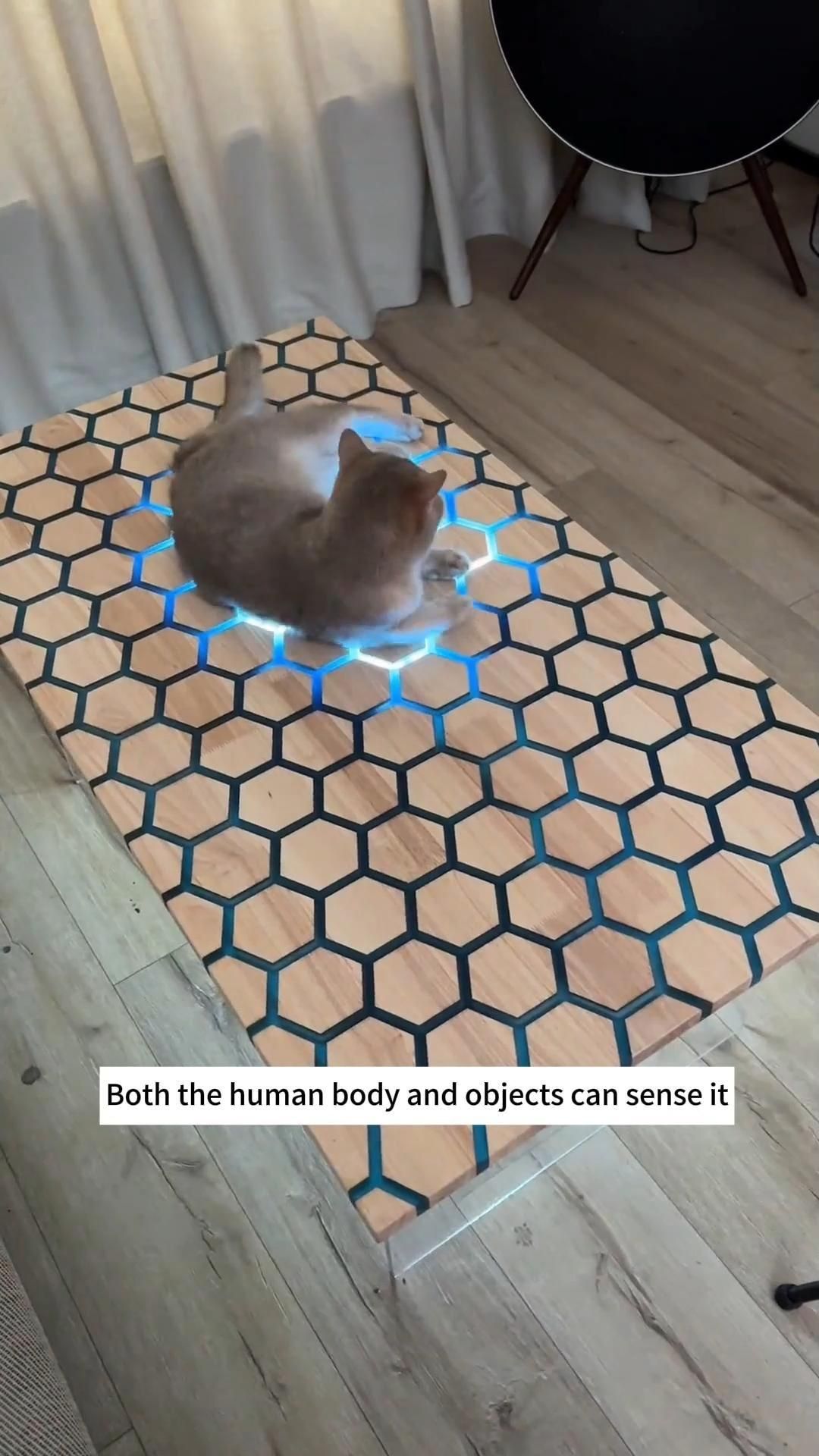
An interactive resin table that lights up exactly where you touch it
This touch-sensitive LED honeycomb resin table turns a standard tabletop into a responsive light surface. Built from a hardwood slab with a carved hexagonal grid, tinted epoxy resin channels, and hidden sensor-triggered LEDs underneath, it blends furniture-making with simple interactive electronics in a way that feels far more architectural than decorative.
The Standout Appeal & Why It Caught Our Attention
Most LED furniture floods the whole surface with light. This one is more interesting because it uses localized activation: only the cells around your hand, cup, bottle, or other object illuminate. That makes the table feel less like a lamp and more like a living interface built into wood.
- Honeycomb geometry gives the tabletop a clean, engineered look while naturally dividing the surface into sensor zones.
- Blue-tinted epoxy channels act as both visual inlay and light guide, helping the glow travel through the pattern instead of blasting upward from a single point.
- Hidden capacitive sensing preserves the minimalist look. There are no visible buttons, switches, or raised modules interrupting the wood grain.
- Acrylic-style transparent legs make the top appear to float, which enhances the illuminated effect at night.
It stands out because it solves a familiar problem in a more elegant way: adding ambient light to a room without introducing another lamp, strip light, or glowing plastic accessory.
Key Features & How It Works
From the build sequence and final result, the table appears to use a hardwood or oak-style top CNC-carved into repeating hexagonal cells. The grooves are filled with colored epoxy resin, then sanded flush for a smooth, furniture-grade surface. On the underside, each active zone contains a compact lighting-and-sensor module.
- Tabletop material: hardwood/oak-look board with a natural grain finish.
- Pattern construction: CNC-routed hexagonal grid for consistent spacing and clean edges.
- Resin inlay: translucent blue epoxy in the channels, allowing light to diffuse through the honeycomb lines.
- Sensor system: concealed capacitive touch or proximity sensors under individual cells detect a hand or object placed above.
- Lighting layout: circular LED rings or short LED strips mounted beneath each active cell create a concentrated halo effect.
- Localized response: only the touched or occupied area lights up, rather than the entire tabletop.
- Power setup: likely low-voltage DC via transformer or adapter, with internal wiring distributed across the underside.
- Base options: clear acrylic legs, or in some commercial versions, wood or metal support frames.
The practical advantage of this design is that the electronics stay mostly invisible while the resin channels become the light path. In daylight, it reads as a modern geometric wood table. In low light, it becomes an interactive accent piece.
Practical Everyday Uses
This is not just novelty furniture. It works especially well in spaces where people want ambient lighting, conversation-starting design, and functional surface use in one object.
- Living room coffee table: place a drink, book, or your hand on the surface and the table responds with a soft glow, adding mood lighting during movies or evening lounging.
- Studio or creative office centerpiece: ideal for design-forward interiors where ordinary desks and side tables feel visually flat.
- Hospitality or entertainment spaces: a lounge, game room, showroom, or reception area can use it as interactive decor that guests immediately notice and test.
It is also surprisingly pet-friendly in the sense that the surface can react to a cat or other object resting on it, which makes the interaction feel playful without needing an app or remote.
Things To Consider Before Buying
Because this is a specialized furniture piece, buyers should treat it more like a custom electronic table than a standard coffee table.
- Confirm dimensions carefully: many versions are custom-built, so width, height, and leg style can vary a lot.
- Check power requirements: ask whether it uses USB, a wall adapter, or an external transformer, and where the cable exits the table.
- Ask about sensor behavior: some builds detect only direct touch, while others also respond to conductive objects like bottles, cups, or phones.
- Understand finish durability: epoxy and wood are durable, but you should still verify scratch resistance, heat tolerance, and recommended cleaning method.
- Expect handmade variation: if buying a custom or small-batch version, resin tint, wood grain, brightness, and wiring layout may differ slightly from the video.
- Weight and moving: solid wood plus embedded electronics can make the top heavier than it looks, especially with thick slabs.
If you want furniture that doubles as interactive ambient lighting, this is a far more distinctive option than a normal LED desk or side table, provided you’re comfortable with the realities of custom-built electronic furniture.