
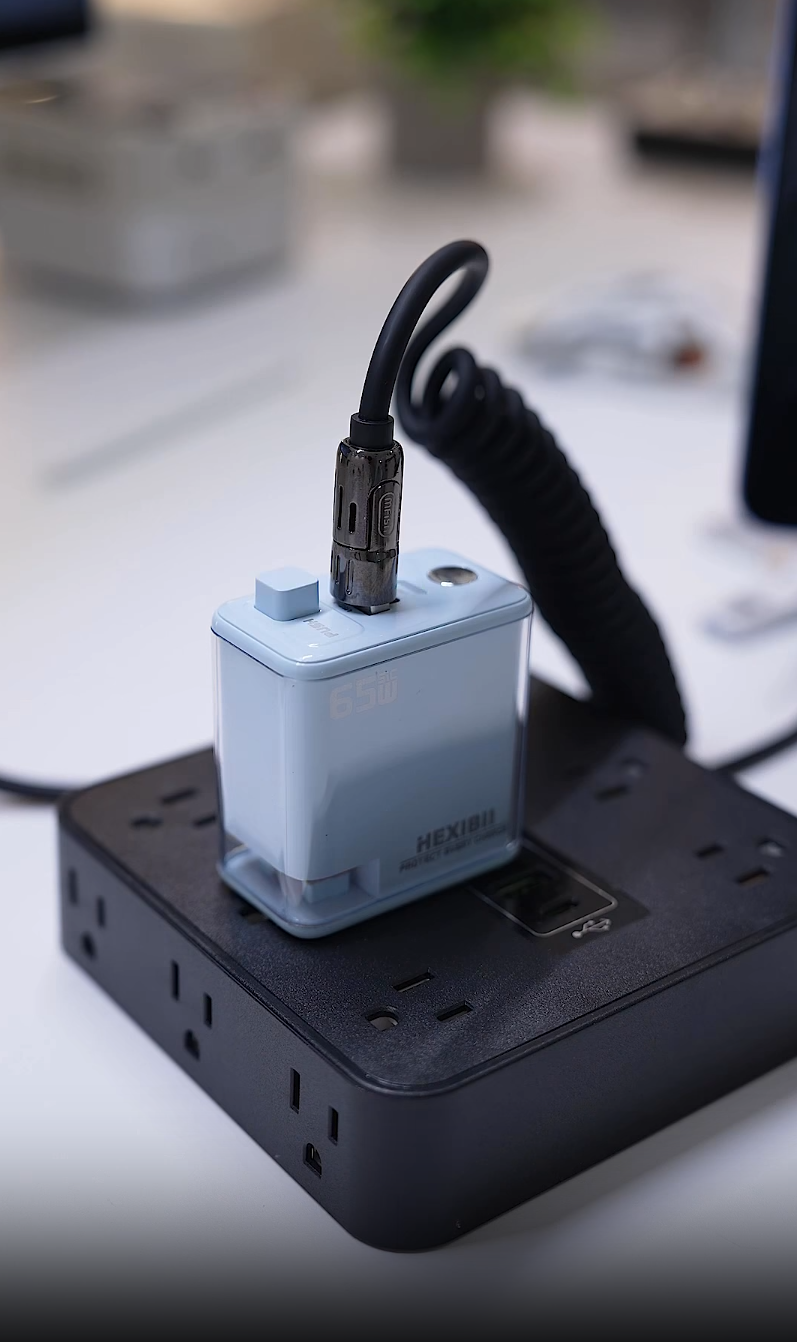
A 65W charger that doesn’t just stop charging in software—it physically cuts power
Most compact fast chargers promise speed and protection, but the HEXIBII E11 adds something much rarer: a visible, hardware-level shutoff mechanism. Once a supported device is fully charged, this wall charger can physically disconnect power rather than simply idling in a trickle state. That makes it especially interesting for nightstand use, travel kits, and anyone who likes the reassurance of seeing a charger truly switch itself off.
The Standout Appeal & Why It Caught Our Attention
The unusual part here isn’t the 65W output alone—it’s the combination of fast charging, a mechanical auto power-off design, and a body that visibly shows the disconnect action. In the images, the charger uses a compact block form with a translucent lower shell and a pop-up style top button element, making the safety system feel tangible instead of hidden behind marketing language.
That physical approach changes how the charger feels in daily use. For bedside charging, it answers a very specific anxiety: whether your phone is still sitting on powered standby all night. HEXIBII’s design philosophy seems to focus on making protection visible, deliberate, and hardware-based, which is a refreshing shift from ordinary GaN-style chargers that look identical but behave like any other adapter.
- Physically disconnects power after full charge on supported devices
- Short-circuit response is designed to cut electricity flow rapidly if a cable fault is detected
- Three charging modes give more control than typical plug-and-forget adapters
- SiC internals aim for cooler, more efficient operation in a small footprint
Key Features & How It Works
The HEXIBII E11 Auto Power-Off Charger is a dual-port wall adapter with 1 x USB-C and 1 x USB-A, rated for up to 65W. Based on the provided product info and the visual demo, the USB-C port is the main high-speed output for newer phones, tablets, and even certain laptops, while the USB-A port adds compatibility for older accessories.
What makes it different is the internal hardware-level cutoff system. Instead of merely reducing current after a battery reaches 100%, the charger can trigger a physical disconnect. In the video context, the top button visibly pops back up, indicating the output path has been mechanically interrupted. That’s paired with an illuminated mode indicator and a front-facing control layout that includes:
- USB-C and USB-A ports on the front face for easy access
- Mode indicator light that changes color to show charging behavior
- Push/mechanical reset-style button tied to the physical disconnect system
- Round control button for selecting charging modes
The three operating modes shown are particularly useful:
- Green mode: intended for high-power devices such as phones charging at faster rates, tablets, and some USB-C laptops
- Blue mode: for lower-power gadgets that may not need the more aggressive power profile
- White mode: keeps power continuously on, useful when you don’t want auto shutoff interfering with active use
Internally, HEXIBII uses Silicon Carbide (SiC) semiconductor technology rather than standard silicon-only architecture. In practical terms, that helps the charger remain compact while handling high wattage more efficiently and with less heat buildup. The casing also appears to use a dual-layer construction with a clear outer shell, which visually emphasizes the internal mechanism and may add some impact protection.
Another key safety feature is its cable and short-circuit monitoring. One of the image sequences shows exposed conductors being used to demonstrate fault detection, with the charger cutting power rather than continuing to energize a compromised cable. That’s the kind of feature that matters most when chargers live on a nightstand, in a hotel room, or around heavily used cables that see frequent bending.
Practical Everyday Uses
This is the kind of charger that makes the most sense when charging habits and safety preferences matter more than simply having another USB brick in a drawer.
- Bedside overnight charging: Plug in your phone before sleep, let the charger fast-charge it, and allow the hardware auto shutoff to handle the rest. For people who dislike leaving adapters energized all night, this is its clearest use case.
- Travel and hotel use: A single compact 65W charger can handle a phone, tablet, earbuds, or even a USB-C laptop, while the physical shutoff feature adds peace of mind in unfamiliar outlets and temporary setups.
- Desk setups with mixed devices: Use green mode for your phone or tablet, blue mode for smaller accessories, and white mode when a device needs uninterrupted power while actively in use.
Things To Consider Before Buying
The E11 is more specialized than a standard fast charger, so it’s worth checking whether its strengths line up with how you actually charge.
- Auto shutoff behavior varies by device: the supplied specs indicate very fast cutoff for newer iPhones, while other phone brands may shut off within a broader 5–50 minute range after reaching full charge.
- Continuous-power users should use the right mode: if you run accessories that need constant power while operating, white mode is the important setting to understand before relying on it.
- 65W is strong, but not universal for every laptop: it will suit many USB-C laptops and tablets, but larger performance laptops may require higher wattage than this charger can provide at full speed.
- Physical size is still compact, not tiny: because it includes the safety disconnect hardware, expect it to be a little more purpose-built than the smallest minimalist chargers.
- Best value comes from the safety feature: if you only need raw charging speed, cheaper adapters exist; this charger makes the strongest case for buyers who specifically want visible hardware-level power cutoff.