
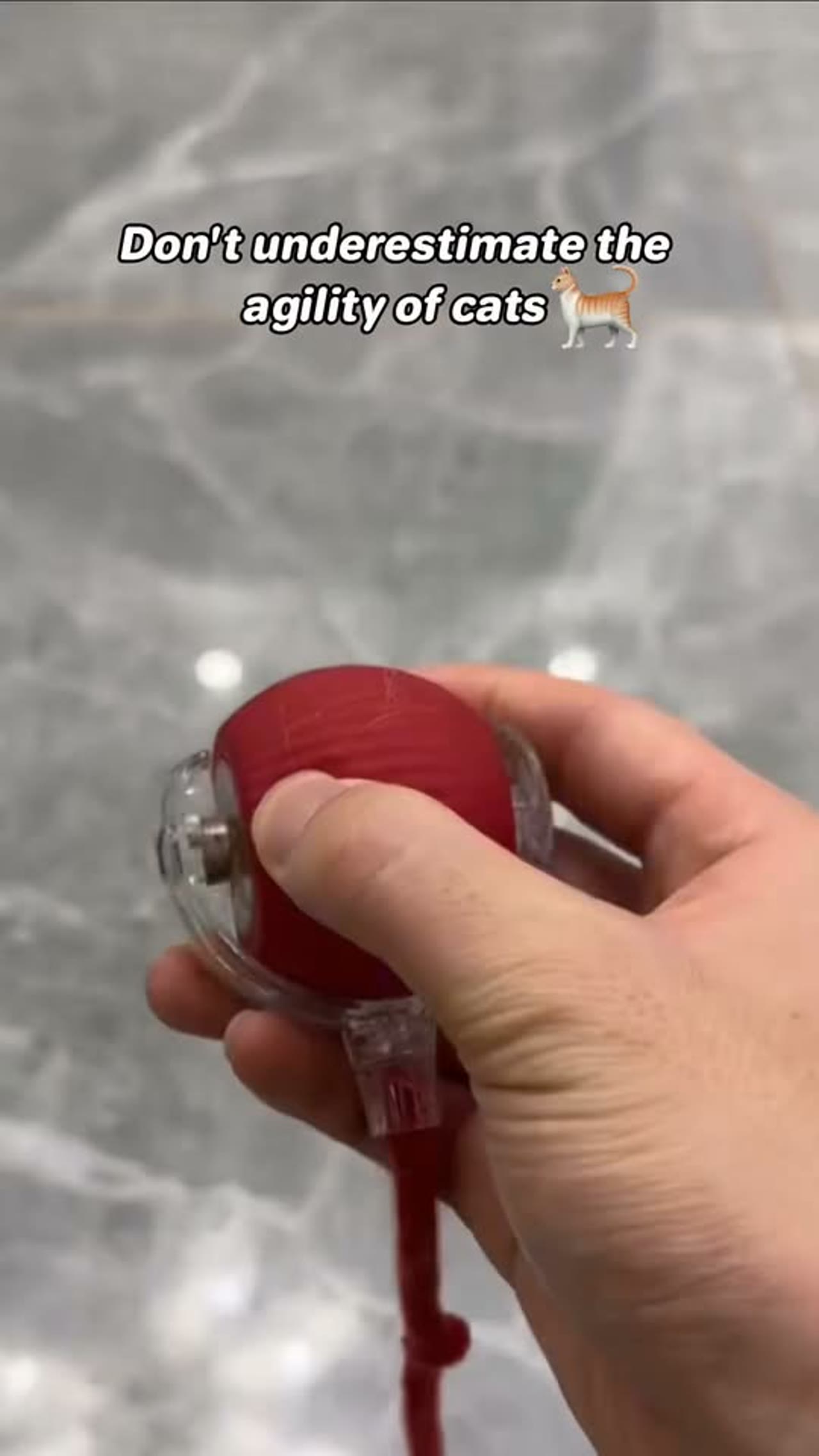
A self-propelled prey toy that turns a simple ball into a moving target cats actually want to stalk
This rolling pet toy takes the usual cat ball concept and adds motion logic, a flicking tail, and mode-based behavior so it behaves less like a static toy and more like a tiny escaping creature. The key draw is that it can roam on its own, change direction when it meets obstacles, and reactivate play with touch, which helps keep indoor cats engaged without requiring constant human teasing.
The Standout Appeal & Why It Caught Our Attention
Most pet balls stop being interesting the moment a cat realizes they only move when batted. This one changes that by combining erratic rolling movement with a whipping tail teaser, which is exactly the kind of visual trigger that taps into a cat’s chase-and-pounce instincts. In the footage, the toy skitters across hard flooring, darts away from paws, and keeps the tail trailing behind like a small prey animal trying to escape.
- More lifelike than a normal ball: the dangling tail adds a second moving target, so cats don’t just chase the sphere itself.
- Better for independent play: it creates motion without a wand toy or owner intervention every few seconds.
- Designed for unpredictability: the toy’s appeal comes from not moving in a straight, repetitive path.
Key Features & How It Works
The product is commonly sold as an Interactive Cat Dog Ball Toy or Speedy Tail 2.0 / 3.0. It uses a one-button control system with LED color indicators to switch between different play personalities.
- 3 play modes: Fast mode for energetic pets, Slow mode for gentler movement, and Interactive mode that stays more dormant until the toy is touched or nudged.
- Color-coded LEDs: listings typically use blue for fast mode, purple for slow mode, and yellow for motion-activated interactive mode.
- Obstacle avoidance: a built-in sensor system helps the ball reverse or redirect after hitting walls, chair legs, or room corners.
- Tail mimic design: the detachable braided mesh rope tail flexes and snaps around behind the ball to simulate fleeing prey.
- Rechargeable internal battery: usually charged via USB to USB-C, with roughly 30 to 45 minutes of charging for up to 6 hours cumulative play, depending on mode and use.
- Durable shell construction: the outer body is typically made from scratch-resistant silicone paired with drop-resistant polycarbonate plastic.
- Twist-lock shell: helps secure the body during rough batting and moderate biting.
- Smart power saving: it generally powers down after about 5 minutes of continuous activity, then can wake with a tap.
Visually, the toy shown has a red textured ball body, a clear side housing that reveals the motorized structure, and a glowing light element that makes its movement easier for pets to track across the floor.
Practical Everyday Uses
This is the kind of pet accessory that makes the most sense for animals that need stimulation but don’t always get long play sessions with a person.
- Indoor cats with high prey drive: ideal for cats that sprint through the house at night, stalk corners, or obsess over string toys. The rolling tail gives them something to hunt without setting up a full play session.
- Busy owners who want autonomous enrichment: if you work from home or leave for parts of the day, this toy can help break up boredom with short bursts of movement-based activity.
- Multi-pet homes with smooth floors: the toy works especially well in open living rooms, dining areas, and hallways where it has space to dart around chair legs and furniture.
Things To Consider Before Buying
As clever as it is, this toy performs best in the right environment and with the right pet temperament.
- Floor type matters: it is best on hardwood, tile, laminate, or other flat hard surfaces. It may work on thin rugs, but thick carpet can reduce its rolling ability.
- Not every pet likes fast motion: shy cats, older pets, or noise-sensitive animals may do better starting in slow mode.
- Tail wear is normal: because the trailing tail is the part pets target most, it may be the first component to fray over time.
- Furniture clearance helps: although it has obstacle avoidance, homes with very low sofas or cluttered floors may still interrupt the toy’s roaming path.
- Supervision is smart for strong chewers: the shell is tougher than a basic toy ball, but it is still better suited to chasing and batting than aggressive chewing sessions.