
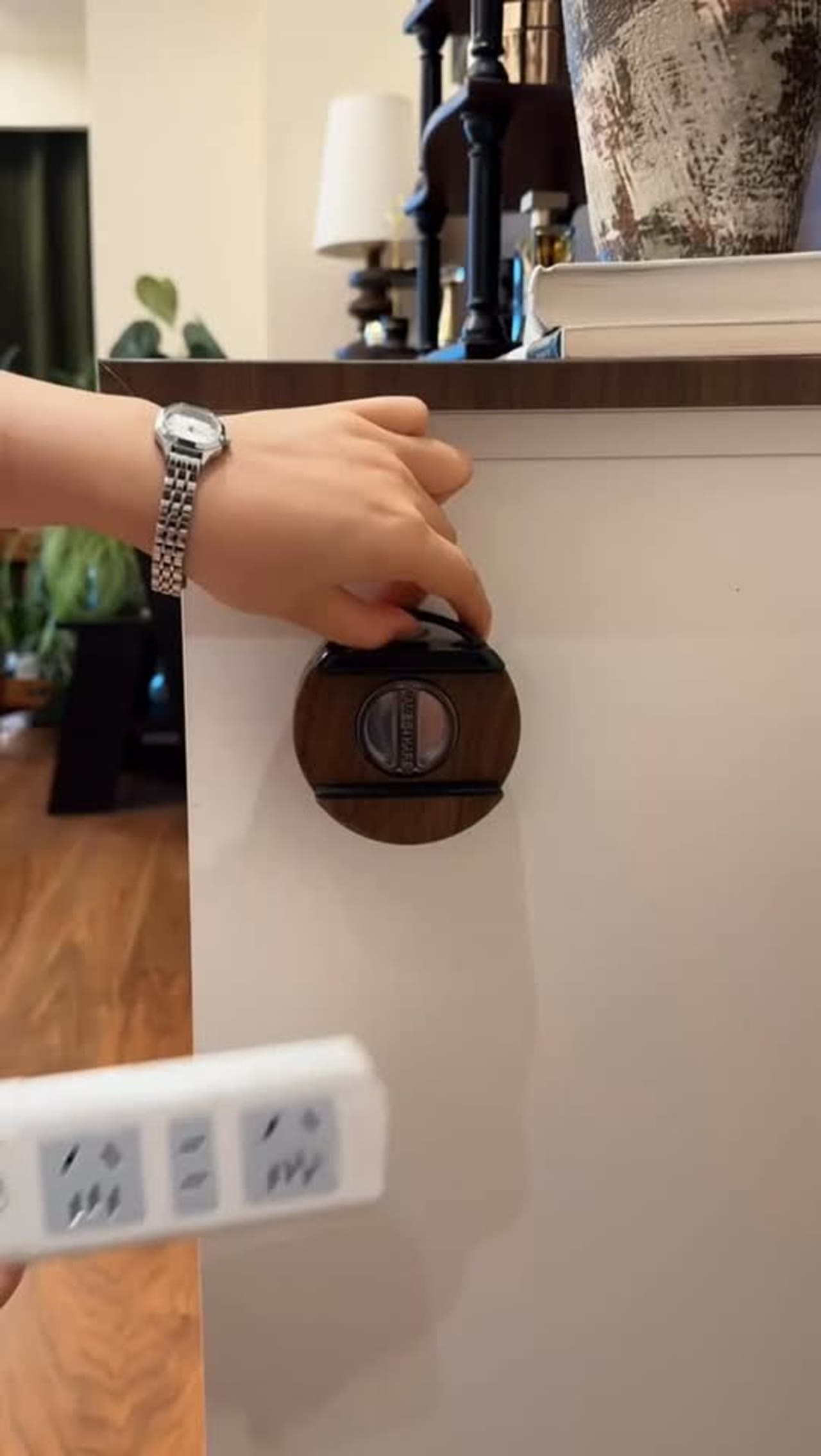
A drill-free way to get bulky power strips off the counter and onto the wall
This compact wall-mount holder is designed for one very specific household annoyance: power strips that never seem to stay where you want them. Instead of leaving an extension block on the floor, dangling from a counter edge, or loosely balanced behind appliances, this mount uses a vacuum suction base and adjustable retaining rails to hold the strip vertically on smooth surfaces. The result is cleaner cable routing, easier plug access, and a much tidier kitchen, desk, or utility area.
The Standout Appeal & Why It Caught Our Attention
Most cable organizers deal with wires after the mess has already happened. This one tackles the bigger problem first: where the power strip itself lives. That makes it more useful than a simple cord clip or adhesive hook.
- No-drill installation means it can be mounted on tile, glass, polished stone, glossy cabinets, or other smooth non-porous surfaces without tools.
- Adjustable clamping rails let it hold more than one exact strip size, which is important because extension blocks vary widely in thickness.
- Built-in rotation helps angle the strip for easier plug insertion, especially when using bulky adapters.
- Cord wrap functionality turns the circular body into a mini cable spool, reducing the usual loop of excess wire hanging behind appliances.
Visually, it also stands out from generic utility hardware. The rounded body and wood-grain finish make it look more like a small home accessory than an industrial bracket, which helps in visible spaces like kitchens and coffee stations.
Key Features & How It Works
The holder appears to use a thick ABS plastic body paired with a reusable silicone vacuum suction pad. Based on the provided product info, it measures roughly 9 × 9 × 5.1 cm and weighs around 145g to 160g, so it stays compact while still offering enough surface area for grip.
- Twist-lock suction mechanism: Press the suction cup onto a smooth surface, then rotate the center dial clockwise to create a tighter vacuum seal. To remove or reposition it, rotate the dial back counter-clockwise.
- Dual installation options: Depending on the listing version, it may include both the vacuum mount and a removable self-adhesive backing for surfaces where suction is less practical.
- Sliding guardrails: The upper and lower rails create a cradle for the power strip, with adjustable depth up to about 8 cm to better fit standard extension leads, surge protectors, remotes, or small adapters.
- 360° rotation: A central spindle allows the mounted strip to rotate, which is especially helpful when plug heads are oversized or cables need to exit in a cleaner direction.
- Cable management ring: Excess cord can be wrapped around the circular housing, keeping loops controlled instead of trailing across the backsplash or countertop.
From the images, the holder is being used exactly where this design makes sense: on kitchen tile and cabinet-side panels, lifting a multi-outlet strip into a more accessible position while keeping appliance cords organized.
Practical Everyday Uses
This is the kind of organizer that becomes surprisingly useful once you have a fixed charging or appliance zone.
- Kitchen appliance station: Mount a power strip above the counter near kettles, coffee machines, blenders, or hot water dispensers so plugs stay accessible and cords stay off wet or messy surfaces.
- Desk or workshop edge: Attach it to a smooth side panel, cabinet, or partition to keep a surge protector off the floor and easier to reach for chargers, lamps, and tools.
- Rental-friendly organization: In apartments or dorms where drilling is not ideal, it offers a removable way to create a cleaner charging setup on tile, glass, or glossy furniture panels.
It is especially helpful for anyone dealing with limited outlet access, counter clutter, or awkwardly placed extension blocks behind appliances.
Things To Consider Before Buying
This is a clever organizer, but it is surface-dependent and works best when matched to the right environment.
- Best on smooth, non-porous surfaces: Think tile, marble, glass, mirror, acrylic, or glossy metal. It is not ideal for textured drywall, wallpaper, rough wood, or matte painted walls.
- Check your power strip dimensions: The adjustable rails help, but very thick surge protectors or unusually shaped outlet blocks may not fit as securely.
- Mind the total load and leverage: The holder supports the strip itself, but heavy transformer plugs can add forward pull. A compact strip with balanced plug placement will be more stable.
- Clean the mounting area first: Suction systems perform much better on grease-free, dust-free surfaces, especially in kitchens.
- Not a substitute for electrical safety: It organizes the strip, but users should still keep cords away from heat, water splash zones, and overloaded outlet setups.
For the right surface and a standard extension block, this is a smart little upgrade that turns a messy power strip into a much more intentional part of the room.