
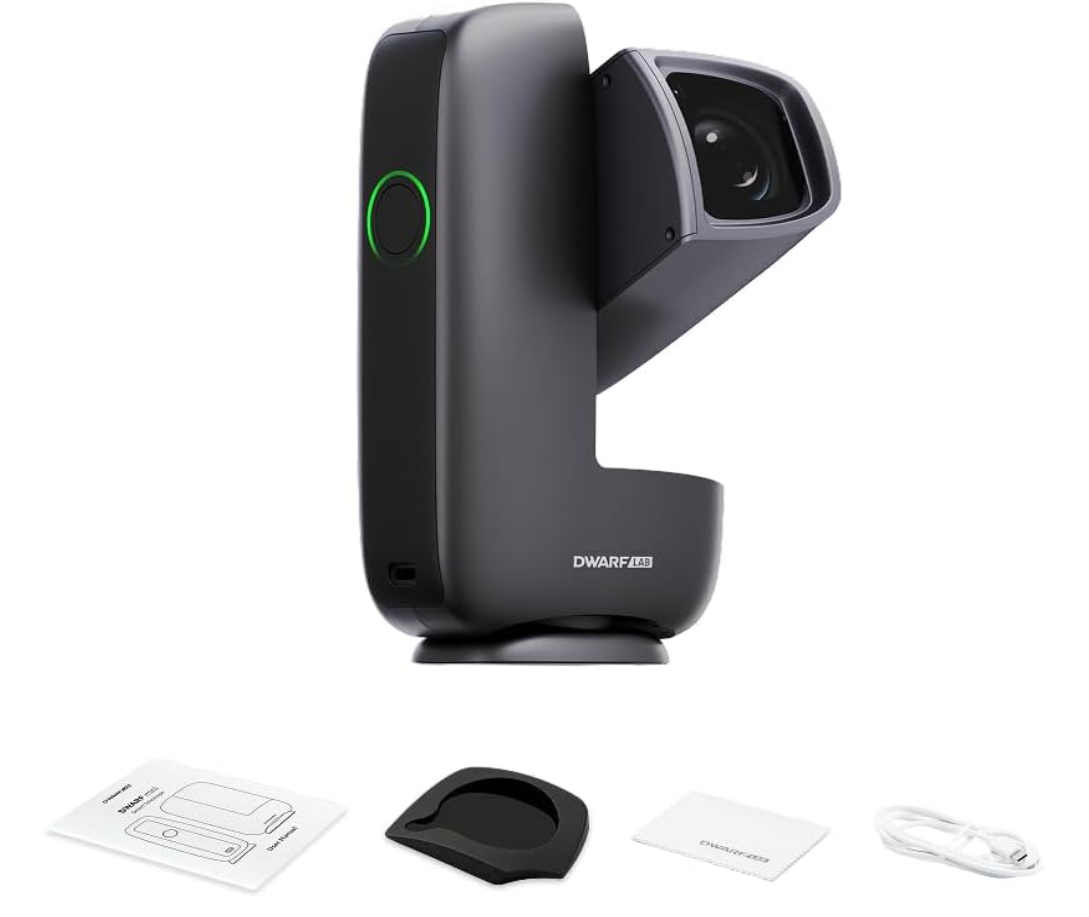
A pocket-size telescope that finds, tracks, and photographs the sky for you
The DWARFLAB Dwarf Mini Smart Telescope takes a category that usually demands tripods, alignment routines, and a fair amount of patience, then compresses it into a compact motorized unit you can carry in one hand. From the images, it’s clearly built around app-guided targeting and automated solar tracking, with the telescope itself doing the hard part: locating the subject, following it, and capturing a stabilized image rather than asking the user to manually chase the sky.
The Standout Appeal & Why It Caught Our Attention
What makes this telescope interesting is not just that it is small, but that it is structurally designed like a smart imaging tool rather than a traditional optical tube. The body looks more like a compact robotic camera head than a classic telescope, which is exactly the point. It is meant for people who want astronomy to feel accessible, portable, and digital-first.
- Ultra-portable format: At just 1.85 lb, it is light enough for travel, camping, or spontaneous backyard sessions.
- Motorized intelligence: The app can automatically align, point, and track targets with Auto GOTO, removing one of the biggest barriers for beginners.
- Solar-to-deep-sky flexibility: The included solar filter and built-in astro filters suggest this is not a one-trick moon viewer, but a broader astrophotography tool.
- 360° pivot freedom: The rotating arm design gives it a much wider aiming range than many compact scopes.
In short, it feels like a telescope for people who are more likely to explore the sky through a phone screen and saved images than through an eyepiece.
Key Features & How It Works
The Dwarf Mini combines optics, motors, onboard processing, and app control into a single self-contained unit. The images show a compact vertical body with a side-mounted optical arm, a stable base, and a USB-C charging port near the bottom. The finish appears to be a smooth matte gray and black housing, giving it a clean, modern field-tool look.
- Dual imaging system: It pairs a 150mm telephoto lens with 30mm aperture for the moon, sun, and deep-sky targets, plus a 6.7mm wide-angle lens for constellation framing and wide-field sky scenes.
- Sony IMX662 sensor: This sensitive 1/2.8-inch sensor with 2.9 µm pixels is designed to keep noise down while capturing Full HD 1920×1080 image data.
- App-controlled targeting: On iOS or Android, the DWARFLAB app acts as the command center. The visual frames show the telescope actively searching for and following the sun, confirming automated target acquisition in real use.
- AZ and EQ modes: Standard Alt-Azimuth tracking is easier for casual use, while Equatorial mode enables longer single exposures up to 90 seconds with reduced star trailing.
- Built-in filters: It includes an Astro broadband filter, a Duo-Band narrowband filter for cutting through light pollution and improving nebula contrast, plus an automated Dark Frame calibration function.
- Solar-ready setup: A magnetic clip-on solar filter is included, which is essential for safe solar imaging and clearly relevant to the sunspot footage shown.
- Onboard storage and power: With 64GB internal storage and a 7,000mAh battery, it is built for untethered sessions of around 4 hours.
- Built-in processing: Instead of dumping all the work onto the phone, the telescope handles part of the imaging and tracking workflow internally.
The practical advantage is that you are not just aiming a lens at the sky. You are using a compact robotic mount, camera, and telescope that cooperate to keep the target centered and usable.
Practical Everyday Uses
This is the kind of astronomy gear that makes sense for people who want to observe more often because setup friction is lower.
- Backyard solar and lunar sessions: If you have 15 free minutes in the afternoon or evening, you can set it down, connect your phone, and capture sunspots or moon detail without hauling out a full-size mount.
- Camping and travel astrophotography: Its low weight makes it realistic to pack for road trips, cabins, or hikes where a conventional telescope would stay home.
- Beginner-friendly sky exploration: Someone new to astronomy can use the app’s sky atlas and Auto GOTO features to find targets without learning manual star-hopping first.
It is especially useful for users who care as much about capturing and sharing images as they do about live viewing.
Things To Consider Before Buying
As clever as the Dwarf Mini is, it helps to know what kind of astronomy experience it is built for.
- This is a smart imaging telescope, not a traditional eyepiece-first scope: If you want classic visual observing through interchangeable eyepieces, this is a different workflow.
- Battery runtime matters: Around 4 hours is solid for portable use, but longer nights may require planning around charging or session length.
- App dependence is central: Many of its best features, including target selection and tracking, rely on using the companion app comfortably.
- Light pollution still affects results: The built-in filters help, especially for nebula work, but darker skies will still improve deep-sky imaging.
- Solar use requires proper filter discipline: Only use it for solar observation with the included magnetic solar filter correctly attached.
- Resolution expectations: Full HD capture is practical and shareable, but buyers expecting dedicated high-end astrophotography camera output should view this as a convenience-focused system.
For the right buyer, the appeal is simple: less setup, less guesswork, and more actual time spent observing and recording the sky.