
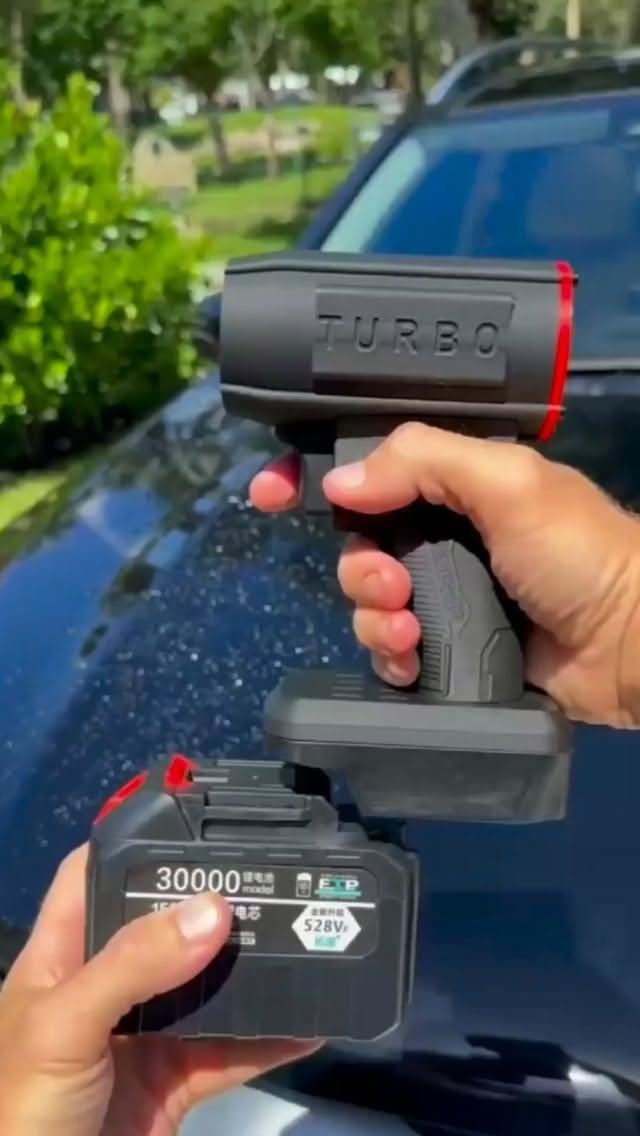
A handheld turbo blower that dries a car without dragging towels across the paint
This compact cordless air blower is built around one simple idea: use a concentrated stream of high-velocity air to push water, dust, and loose debris out of tight surfaces fast. From the images, it appears styled like a mini power tool with a pistol grip, detachable slide-on battery pack, and a turbine-style front intake, making it especially appealing for car drying and detail work where towels, bulky leaf blowers, or canned air feel clumsy.
The Standout Appeal & Why It Caught Our Attention
What makes this category interesting is how it shrinks the logic of a shop blower into a much more one-handed, targeted format. Instead of flooding a whole area with air, this design focuses on precision airflow for mirrors, badges, grilles, lug areas, trim gaps, and other places where water likes to hide. The user-supplied context also points to a high-speed brushless motor reaching up to 150,000 RPM, which explains why these tools are increasingly used as a serious alternative to towels and compressed air for detailing.
- Portable power-tool form factor makes it easier to maneuver around a vehicle than a full-size blower.
- Touch-free drying helps reduce the chance of adding swirl marks during post-wash cleanup.
- Battery-platform compatibility is a major practical advantage for users already invested in tool batteries such as Milwaukee or DeWalt-style systems.
Key Features & How It Works
Visually, this blower uses a compact turbine housing with a front air outlet and a red rear intake guard that exposes the fan architecture. The body has a molded grip with trigger-style control, and the base is designed for a slide-in battery pack, reinforcing its workshop and garage-friendly design. The suggested product info indicates a brushless motor, which is important because brushless systems are typically chosen for higher efficiency, better durability, and the ability to sustain very high rotational speeds.
- Turbo jet airflow for blasting water off paint, glass, mirrors, wheels, and trim.
- Brushless high-speed motor reportedly up to 150,000 RPM for stronger airflow in a smaller body.
- Pistol-grip ergonomics for controlled aiming during close-up work.
- Detachable battery design for cordless use and quick swaps between jobs.
- Protective rear intake grille helps shield the spinning fan while maintaining airflow.
- Rigid polymer housing appears designed to handle garage use without the bulk of a full shop blower.
In practice, the motor spins an internal impeller at extremely high speed, pulling air through the rear intake and compressing it into a focused stream at the front. That concentrated output is what makes it useful not just for broad drying, but for forcing trapped water out of seams and crevices.
Practical Everyday Uses
This is the kind of tool that becomes more useful the more you notice where water and dust collect.
- Car drying after a wash: Blow water out of mirror caps, emblems, grille textures, headlight edges, window trim, and panel gaps before it drips back onto clean paint.
- Garage and workshop cleanup: Clear sawdust, loose dirt, leaves, or bench debris from work surfaces and corners without dragging out a larger blower.
- Interior and electronics dusting: Use controlled bursts to clean vents, mats, cargo areas, and other hard-to-reach spots where a cloth or vacuum attachment is awkward.
Things To Consider Before Buying
Before choosing one, pay close attention to the battery ecosystem and actual compatibility. Many of these blowers are sold in versions made for specific slide-pack formats, so the body may look universal while the battery mount is not. Also remember that ultra-compact turbo blowers trade broad-area coverage for concentrated force, which is great for detail work but may not fully replace a larger dryer for entire vehicles.
- Check battery fitment carefully: confirm whether it is made for Milwaukee, DeWalt, or another battery standard.
- Verify included parts: some listings include only the tool body, while battery and charger are sold separately.
- Expect noise and strong airflow: high-RPM impeller tools can be loud and should be kept clear of loose hair, cords, and lightweight objects.
- Use with care on delicate areas: concentrated air is excellent for crevices, but very close-range use may be overkill on fragile dust or loose items.