
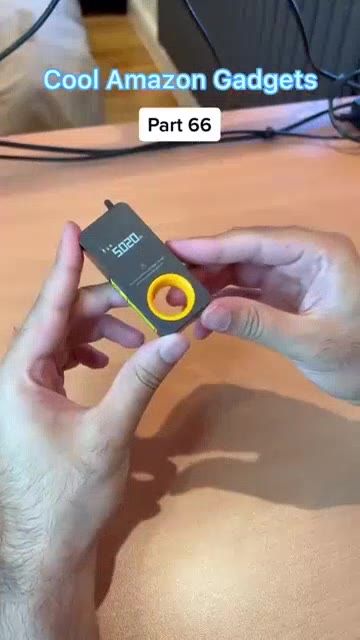
A pocket-size laser measurer that makes quick room, furniture, and wall measurements far easier than a floppy tape measure.
This compact digital distance meter is designed for people who want fast, one-person measuring without wrestling with a retractable tape. The slim rectangular body, bright front display, and oversized circular control ring suggest a product built around simplicity: point, press, and read the result instantly on-screen.
The Standout Appeal & Why It Caught Our Attention
What makes this style of laser measurer interesting is how much friction it removes from everyday measuring tasks. Traditional tape measures are great for rough jobs, but they become awkward when you are measuring across a room, checking furniture fit, or working alone. This unit turns that into a single-handed digital process. Its minimalist body is small enough to live in a drawer, tool pouch, or backpack, yet it handles the kind of measurements people repeatedly need during home projects, moving, decorating, and DIY planning.
- Compact pocket format makes it much more carry-friendly than a standard tape measure.
- Digital readout reduces guesswork and makes results easier to record.
- Laser-based measuring is especially useful for longer indoor distances where tape sag and alignment become annoying.
Key Features & How It Works
From the visuals, this appears to be a portable smart laser distance meter with a clean industrial design. The front has a small screen near the top for displaying measured values, while the large orange circular control area acts as the main tactile interaction point. The measuring end houses the laser emitter/sensor, which projects a beam toward the target surface and calculates distance electronically.
- Front digital display: Shows measurement results clearly without needing a phone or notebook immediately at hand.
- One-button style operation: The large circular control ring is easier to press accurately than tiny side buttons, especially during one-handed use.
- Laser emitter on the end face: Designed to send a beam toward walls, furniture, or other flat surfaces for quick distance readings.
- Slim rectangular housing: Easier to grip, pocket, and align than bulkier construction-grade meters.
- Rechargeable design: The visible charging port indicates it is meant for repeated everyday use rather than disposable battery swapping.
- Minimalist matte finish: The dark body with high-contrast orange accent improves visibility and gives the control area an obvious focal point.
The “smart” aspect here is less about flashy connectivity and more about instant digital accuracy in a very small form factor. You point the unit at a surface, trigger the measurement, and the result appears on the display, making it practical for quick checks around the house or office.
Practical Everyday Uses
This is the kind of tool that becomes surprisingly useful once it is within reach. It suits renters, homeowners, furniture shoppers, DIYers, and anyone who frequently needs dimensions without hauling out a toolbox.
- Furniture and decor planning: Measure the width of a wall, the gap beside a sofa, or the clearance for a shelf before ordering anything online.
- Room and renovation checks: Quickly capture wall-to-wall distances, ceiling heights, or doorway spans when painting, flooring, or planning layouts.
- Moving and storage: Confirm whether a desk, cabinet, or mattress will fit through a hallway, into an elevator, or inside a vehicle.
Things To Consider Before Buying
Laser measurers are extremely convenient, but they work best when used within their intended conditions. Buyers should think about where and how they plan to use it most often.
- Best for hard target surfaces: Flat walls and solid furniture are easier to measure than reflective, transparent, or irregular surfaces.
- Indoor use is usually ideal: Bright outdoor sunlight can make laser targeting less convenient depending on the model.
- Check charging method and battery life: Since it is rechargeable, make sure the port type and runtime fit your routine.
- Know the measurement range and units: Confirm whether it supports the distances and unit system you need for home, office, or workshop tasks.
- Not a total tape-measure replacement: For curved objects, soft materials, or very short edge-to-edge measurements, a traditional tape can still be more practical.