
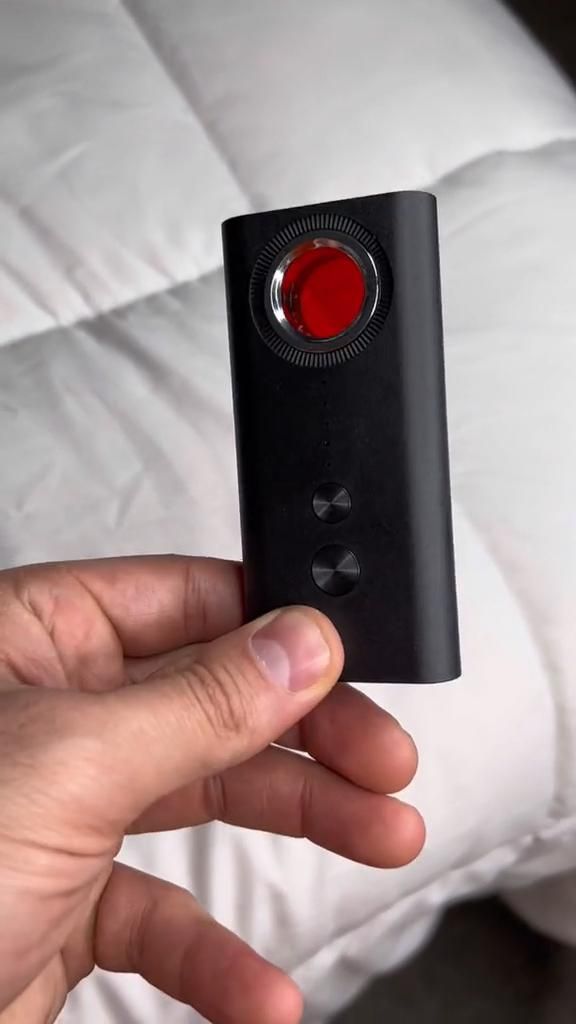
A pocket-sized privacy scanner that helps expose hidden cameras by spotting lens reflections and signal activity.
This compact black handheld tool is designed for one job: helping you check a room for covert cameras before you settle in. Its front-facing red inspection lens, simple button layout, and tiny indicator LEDs suggest a straightforward privacy-sweep workflow rather than a complicated app-based setup.
The Standout Appeal & Why It Caught Our Attention
What makes this item interesting is its purpose-built, no-frills design. Instead of looking like a generic flashlight or power bank, it uses a bold red circular viewing window and a minimal body that feels optimized for quick room checks. That matters because hidden-camera concerns are usually about speed and discretion: you want something you can hold in one hand, scan a bedroom, rental, changing area, or hotel room with, and then put away immediately.
The visual language also signals a very specific use case. The dark matte shell reduces reflections, while the bright lens area draws attention to the scanning optics. In practice, that means the product is trying to make suspicious camera lenses easier to spot in low light, where glass reflections tend to stand out.
Key Features & How It Works
Based on the images, this appears to be a portable hidden-camera detector with a compact rectangular body, two tactile front buttons, and a vertical row of small status LEDs. The top circular red element likely serves as the optical scanning window, used to help reveal reflective camera lenses when you sweep a room in dim lighting.
- Handheld form factor: Small enough to grip between the fingers, making it easy to sweep shelves, vents, décor, and wall fixtures.
- Two-button control layout: The front buttons suggest simple mode switching or power/scan control without a learning curve.
- Status indicator LEDs: The vertical light dots provide feedback during operation, likely showing power level or scan mode.
- Matte black housing: Helps the unit stay visually discreet and comfortable to hold.
- Red optical lens: The most distinctive feature, likely used to help identify hidden camera glass by reflection or illumination behavior.
The video frames show the device being used in a darkened room with plants and furniture, which is exactly the kind of environment where a privacy scan makes sense. The idea is not to “see through” objects, but to make suspicious camera lenses easier to notice when you inspect common hiding places such as smoke detectors, picture frames, shelves, and decorative objects.
Practical Everyday Uses
This kind of tool is most useful when you want a fast privacy check before relaxing or working in an unfamiliar space.
- Hotel and short-term rental checks: Scan the bedroom, bathroom entry, and living area before unpacking.
- Apartment privacy sweeps: Useful for people who want to inspect new rentals, shared housing, or guest rooms for unexpected surveillance devices.
- Travel and content work: Helpful for creators, consultants, or frequent travelers who regularly stay in temporary spaces and want a quick confidence check.
Things To Consider Before Buying
Privacy scanners can be useful, but they are not magic. A device like this works best when you understand its limits and use it as part of a broader room-check routine.
- Lighting matters: Many hidden-camera detectors work best in low light, so don’t expect the same results in a brightly lit room.
- Technique matters: You may need to slowly scan likely hiding spots rather than waving it around casually.
- Battery and charging: Check whether it uses USB charging and how long it lasts on a full charge.
- False positives: Reflective surfaces, mirrors, and glossy décor can sometimes trigger attention, so verification is still important.
- Not a substitute for inspection: It should complement, not replace, a physical check of suspicious objects and fixtures.