
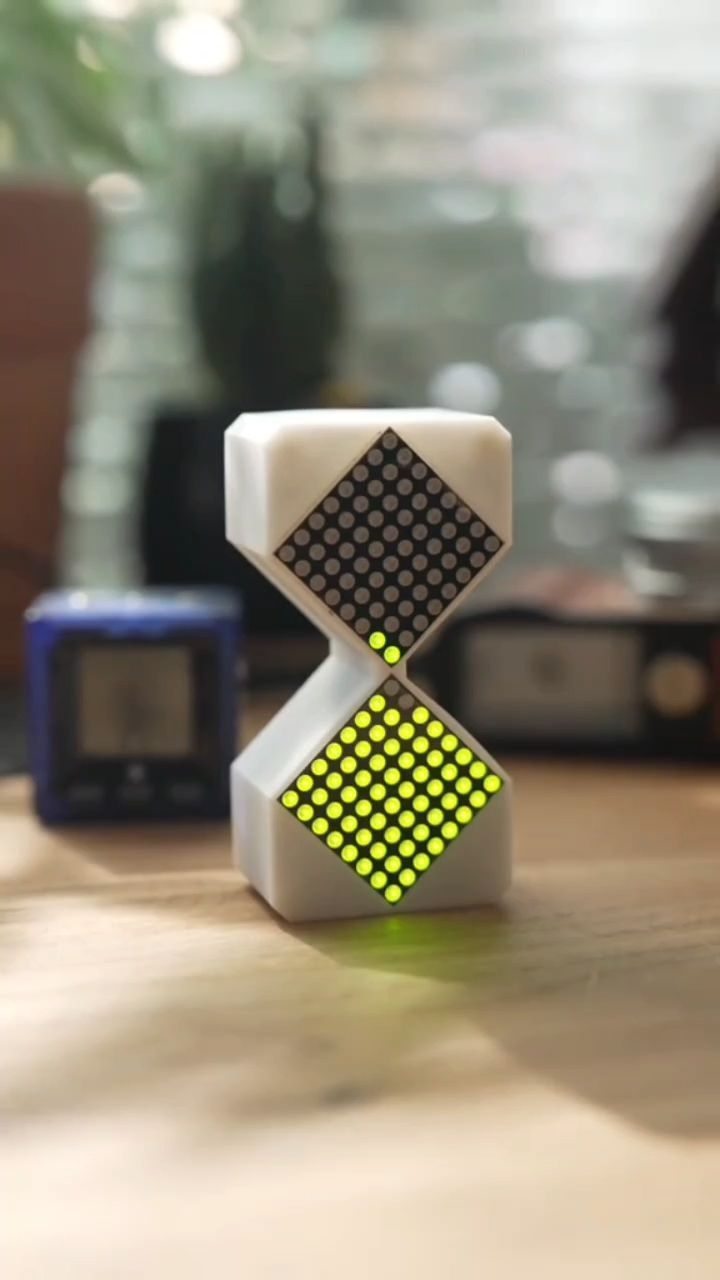
A flip-activated LED hourglass that turns timekeeping into a visual ritual
This is a modern digital electronic hourglass that replaces glass and sand with animated LEDs. Instead of watching grains fall through a fragile bulb, you get a bright matrix display that simulates flowing sand and automatically reverses when the unit is flipped. The result is part timer, part focus tool, and part desk sculpture.
The Standout Appeal & Why It Caught Our Attention
What makes this piece interesting is that it does more than count down silently in the background. It gives time a physical-looking visual behavior. The two diamond-oriented LED panels mimic the top and bottom chambers of a classic hourglass, while the animated dots create the illusion of sand collecting and draining in real time. That makes it far more engaging than a phone timer and much more durable than a traditional glass hourglass.
- Flip interaction: turning it over resets the visual flow in a way that feels intuitive and satisfying.
- Ambient presence: the glowing matrix adds motion and light to a desk, shelf, studio, or bedside table.
- Useful novelty: it is decorative, but it also serves a real purpose for focus sessions, short breaks, and timed tasks.
Key Features & How It Works
The design shown uses two LED dot-matrix panels, likely 8×8 each, mounted in an hourglass-shaped housing. The casing appears to be a compact white shell with angled edges, while the displays are rotated into a diamond orientation to reinforce the hourglass silhouette. Bright yellow-green LEDs simulate falling grains between the upper and lower sections.
- Gravity sensing: an internal orientation sensor detects when the unit is flipped upside down and reverses the animation direction automatically.
- Physics-style sand animation: the lit pixels do not just switch instantly; they appear to flow and gather, creating a more natural hourglass effect.
- Adjustable countdown behavior: many versions of this style support different timing intervals, often in the 1 to 30 minute range.
- Rechargeable power: these are commonly powered by an internal battery and charged by USB, making them easy to move between desk, kitchen, and nightstand.
- Compact freestanding form: the narrow center and weighted top-and-bottom geometry let it stand upright while remaining easy to pick up and flip with one hand.
From the images, the display is bright enough to remain visible in daylight, which is important if you want it to function as more than just low-light decor.
Practical Everyday Uses
This kind of timer works best for people who benefit from a visual cue rather than a hidden digital countdown.
- Desk focus sessions: use it for Pomodoro-style work blocks, reading sprints, journaling, or study intervals without reaching for your phone and getting distracted.
- Kitchen timing: handy for tea steeping, quick baking checks, noodles, or reheating tasks where a short visible timer is enough.
- Ambient decor: place it on a shelf, speaker, or workstation as a kinetic light object that doubles as a conversation piece.
Things To Consider Before Buying
Before choosing one, it is worth checking how the specific version handles timing and charging, since this style exists in both finished retail models and DIY kit form.
- Timer range: confirm whether the unit supports fixed intervals or adjustable countdown lengths.
- Charging port: some versions use USB-C while others still use Micro-USB.
- Brightness and sound: make sure the LEDs are suitable for your room and check whether it includes an audible alert or is visual-only.
- Build type: DIY kits can be fun for electronics hobbyists, but a finished model is better if you want plug-and-play use.
- Use case expectations: this is ideal for short timed routines and visual focus, but it is not a precision replacement for a full-featured clock or app-based scheduler.
If you want a timer that feels less clinical and more tactile, this LED hourglass offers a clever middle ground between functional tool and interactive desk object.