
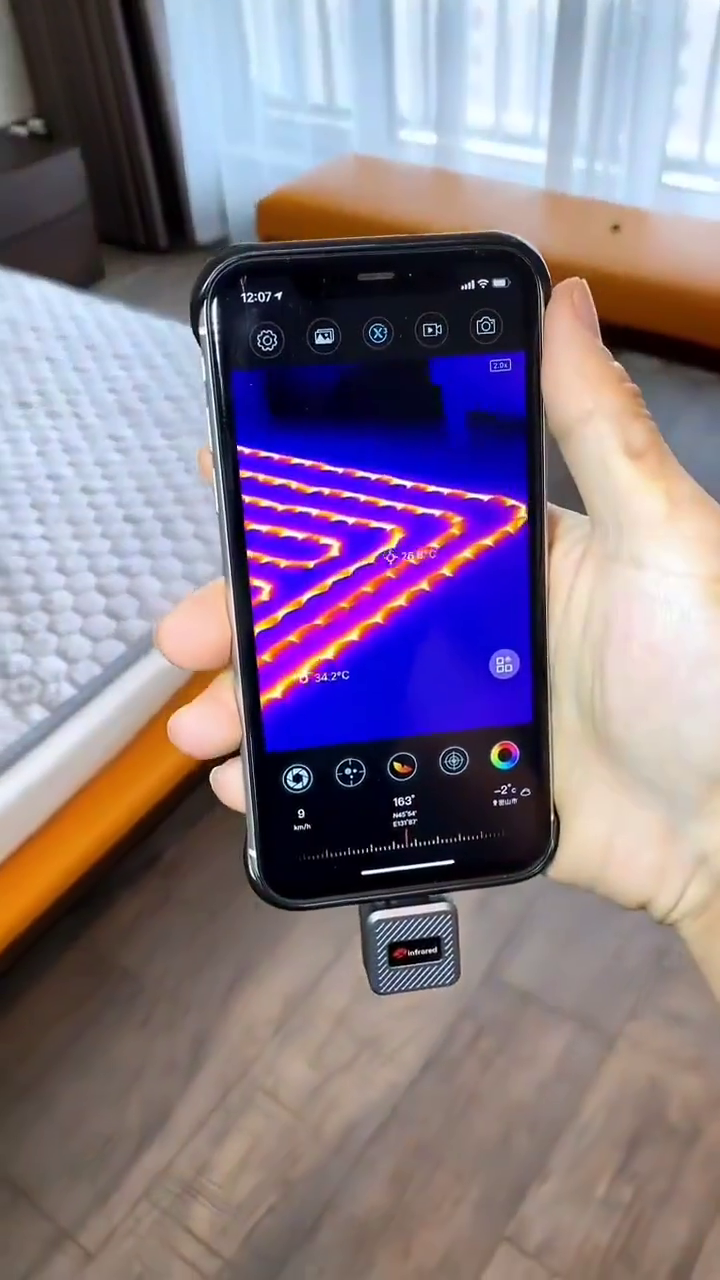
A pocket-size thermal camera that turns your phone into a real diagnostic tool
The HIKMICRO MiniE is the kind of accessory that looks tiny in the hand but opens up an entirely different way to inspect the world. Plug it into a compatible phone, launch the app, and your screen becomes a live thermal view for spotting hidden heat, cold drafts, warm pipes, overloaded electronics, and other problems that ordinary cameras simply cannot reveal.
The Standout Appeal & Why It Caught Our Attention
What makes this especially compelling is how much capability is packed into such a small, phone-powered module. Traditional thermal imagers are often bulky, expensive, and separate from the device you already carry. The MiniE takes the opposite approach: ultra-compact, battery-free, and instantly deployable. That means it is far more likely to be used in real life, whether you are checking floor heating in a hotel room, tracing a leak path at home, or scanning a charger brick that feels suspiciously hot.
- True portability: at roughly 20g, it is light enough to live in a pocket, pouch, or tool bag.
- Phone-first workflow: the large smartphone display makes thermal inspection more intuitive than tiny standalone screens.
- Useful beyond novelty: this is not just a visual trick; it helps reveal insulation gaps, hot circuits, and temperature differences that are otherwise invisible.
Key Features & How It Works
The MiniE is a plug-and-play thermal imaging camera that connects directly to a smartphone through the charging port, with versions available for USB-C or Lightning. It draws very little power from the phone itself, so there is no separate battery to charge or maintain. In the images, the module appears as a compact square body with a protruding lens assembly and a protective cap, designed to stay small while still giving the sensor a clear forward view.
- 96 x 96 IR resolution for native thermal capture, enhanced to 192 x 192 with SuperIR for cleaner, more readable detail.
- Low power draw: approximately 0.31W, which helps preserve phone battery during short inspections.
- Protective lens cap: a simple but important detail for a sensor that may be carried loose in a pocket or bag.
- Live thermal palettes and temperature readouts: the app displays heat patterns in high-contrast color modes, with on-screen spot temperatures and measurement tools.
- Compact rigid housing: the body is built to be handled like a tool rather than a fragile novelty accessory.
In use, the camera reads infrared radiation rather than visible light. Warm objects, heated pipes, electrical hotspots, and body heat appear brighter or in hotter colors, while cooler surfaces show up darker or in cooler tones. That makes it possible to quickly compare temperatures across walls, floors, appliances, wiring, and outdoor scenes.
Practical Everyday Uses
This is one of those rare phone accessories that can be genuinely useful for homeowners, DIYers, tech tinkerers, and even curious travelers.
- Home maintenance: scan walls and floors to locate underfloor heating loops, identify cold insulation gaps, or trace suspicious moisture areas where temperature differs from surrounding surfaces.
- Electrical and electronics checks: inspect power strips, chargers, breaker panels, routers, gaming PCs, or soldering projects for unexpected overheating before it turns into a failure.
- General outdoor and utility use: check pet heat signatures in low light, compare solar panel temperature consistency, or inspect windows and doors for nighttime heat loss.
Things To Consider Before Buying
The MiniE is impressively convenient, but it works best when buyers match it to the right expectations and phone setup.
- Connector compatibility matters: confirm whether you need the USB-C or Lightning version before ordering.
- It depends on your phone: because it is battery-free, runtime and app experience are tied to your smartphone’s battery life and software compatibility.
- Resolution is practical, not industrial-grade: the 96 x 96 sensor is very useful for diagnostics, but professionals needing highly detailed thermal surveys may want a higher-end model.
- Best for temperature differences: thermal cameras are strongest at revealing contrast, so reflective surfaces, glass, and certain materials can require a bit of interpretation.
- App learning curve: to get the most from it, users should spend a little time learning palettes, spot measurements, and how viewing angle affects readings.