
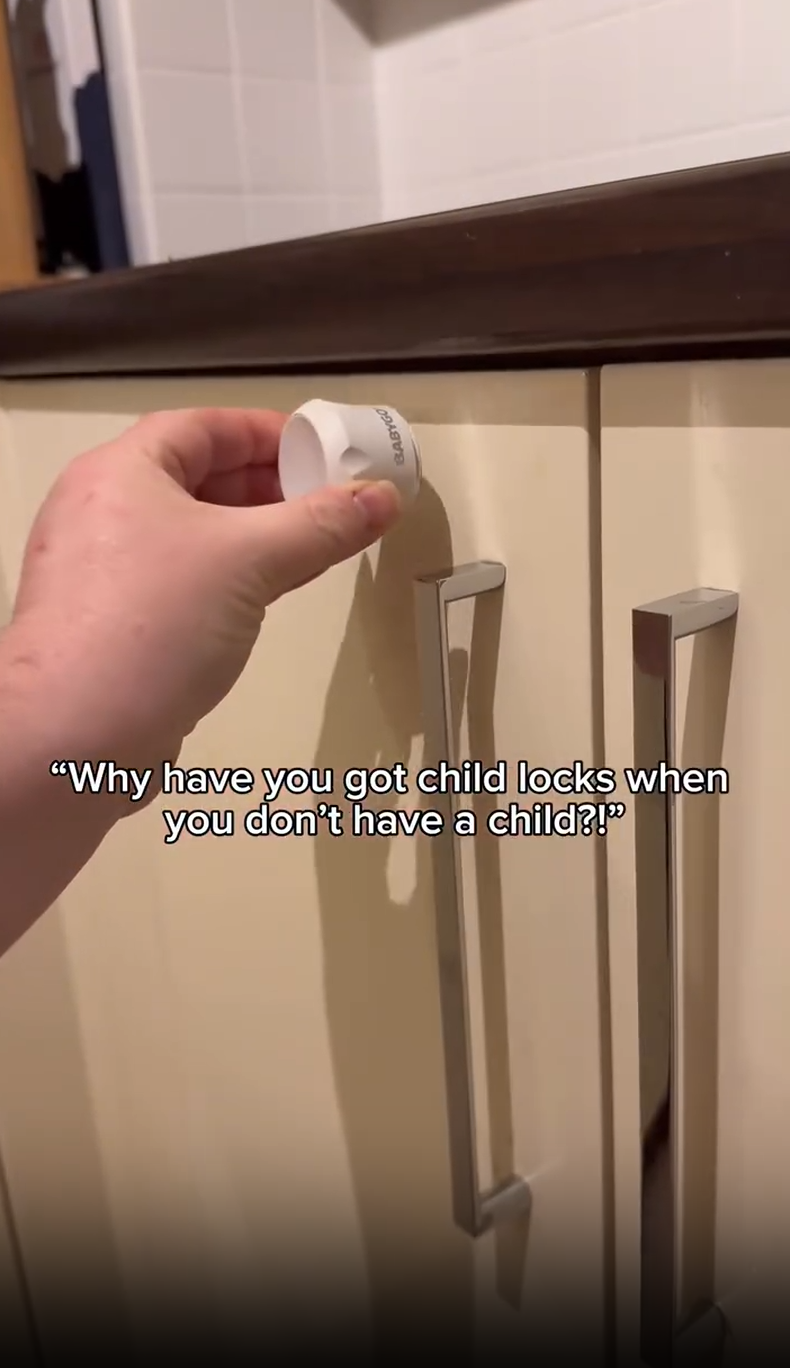
A hidden cabinet lock that keeps curious pets and toddlers out without changing how your kitchen looks
This is the now-popular adhesive magnetic cabinet lock system commonly sold by brands like Vmaisi and Skyla Homes. It mounts completely inside the cupboard, so from the outside your cabinets still look clean and handle-only. The clever part is that the latch stays engaged until you place a magnetic key on the correct spot outside the door, releasing it through the panel with no visible hardware.
The Standout Appeal & Why It Caught Our Attention
Most child locks solve access control by adding something awkward and visible to the outside of the cabinet. This design goes in the opposite direction: it hides the entire mechanism inside the door while still making the cabinet genuinely difficult for small children or determined pets to open. In the video context, that matters because cabinet-raiding cats can learn handles surprisingly fast.
- Invisible from the front: no straps, no plastic clips, no exterior latch to disrupt the kitchen aesthetic.
- Magnetic access: the lock can be disengaged only when a strong magnetic key is placed over the installed latch position.
- Rental-friendly approach: peel-and-stick mounting avoids drilling into cabinet doors in many setups.
It is an unusually elegant answer to a very ordinary household problem: keeping certain doors closed without making the kitchen feel like a daycare or a workshop.
Key Features & How It Works
The system typically consists of an inner latch body, a corresponding catch, and one or more round magnetic keys. The lock body is usually made from white ABS plastic and attaches to the inside of the cabinet using heavy-duty 3M adhesive, with some kits also allowing screw mounting if desired.
- Magnetic release mechanism: when the cabinet is closed, the inner latch catches and prevents the door from opening normally. Bringing the magnetic key to the marked exterior spot pulls the internal mechanism into release position.
- On/off toggle switch: many versions include a small lever on the lock body that disables the latch so the cabinet behaves normally. That is especially useful when guests are over, when the pet problem is temporary, or when constant locking becomes inconvenient.
- No-drill installation: the adhesive-backed parts stick directly to wood, laminate, or melamine cabinet interiors, making them popular for apartments and newer kitchens.
- Concealed setup: because the hardware sits inside the cupboard, there is nothing obvious for a child or pet to grab, chew, pull, or learn from visually.
In practice, that combination is why these locks have spread beyond baby-proofing into pet-proofing, especially for food cupboards, cleaning supply doors, and cabinets storing breakables.
Practical Everyday Uses
This is one of those rare home accessories that becomes more useful the more specific your household chaos is.
- Cat-proofing food cupboards: ideal for smart pets that have figured out how to hook paws around handles and pull open snack, treat, or dry-food cabinets.
- Toddler safety: helps block access to under-sink chemicals, sharp utensils, glassware, and medicine storage without putting bulky locks on the outside.
- Shared-space kitchens: useful in rentals or family homes where you want some cabinets to stay closed during parts of the day, then switch back to open mode using the built-in toggle.
For households with both pets and small children, it is especially practical because it secures the same high-risk storage zones for two very different kinds of curious intruders.
Things To Consider Before Buying
These locks are simple, but they work best when the cabinet setup is compatible and installation is done carefully.
- Door material and thickness matter: the magnetic key must be strong enough to trigger the latch through the cabinet face, so very thick or unusually dense doors can affect performance.
- Surface prep is important: adhesive mounting works best on clean, dry, grease-free interior surfaces. Kitchen residue can weaken the bond.
- Alignment matters: if the latch and catch are installed slightly off, the door may not release smoothly or may require extra force.
- Keep track of the magnetic key: if you misplace it, daily access becomes annoying until you find the spare.
- Not every pet challenge is identical: this stops door opening, but it will not solve broader counter-jumping or item-knocking behavior on its own.
For buyers who want a clean-looking, non-drilled, concealed lock, though, this remains one of the smartest cabinet-control upgrades you can add to a kitchen or bathroom.