
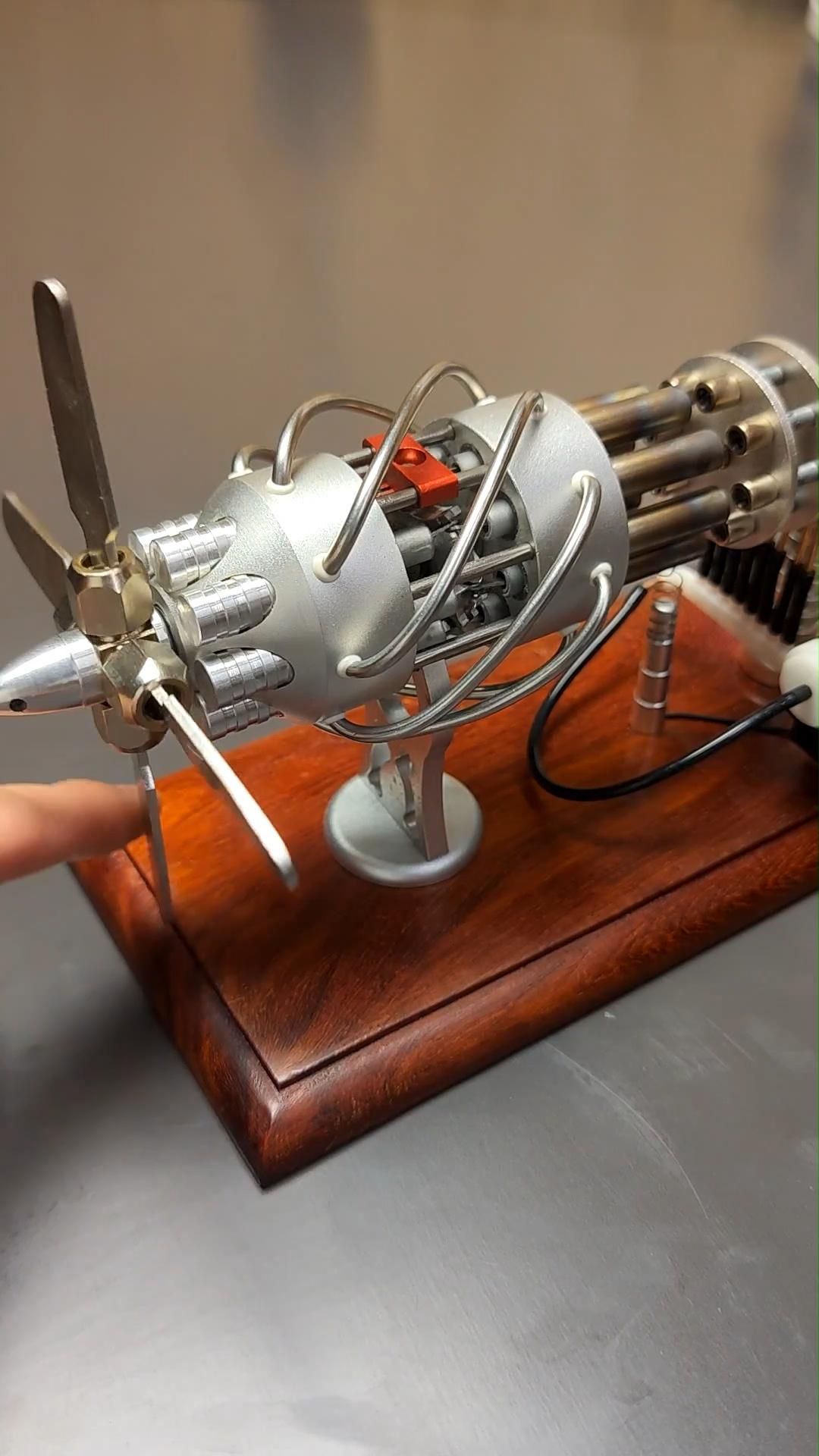
A heat-powered 16-cylinder engine model that turns thermodynamics into moving desktop sculpture
This is the kind of mechanical model that instantly pulls people in because it is not just decorative—it is a fully working external combustion Stirling engine with a dramatic 16-cylinder axial layout, a visible swash plate drive system, and a front propeller that makes the whole thermodynamic cycle easy to see. Mounted on a polished wood base and fed by a small burner, it functions as part engineering demo, part collector display, and part kinetic conversation piece.
The Standout Appeal & Why It Caught Our Attention
Most desktop engine models rely on a simple flywheel and a small number of pistons. This one is far more ambitious. Its appeal comes from combining high part count, visible reciprocating motion, and an unusual swash plate mechanism that converts piston travel into smooth rotary output. The result feels closer to a miniature experimental aircraft powerplant than a classroom toy.
- 16-cylinder configuration gives it a dense, mesmerizing mechanical rhythm rather than the motion of a basic single-cylinder Stirling model.
- Open-frame center section lets you watch the internal linkage and piston action instead of hiding the interesting part behind a casing.
- Propeller-driven output makes the energy conversion obvious at a glance, which is why it works so well as a display and teaching piece.
- Mahogany-style base and machined metal body elevate it from science demo to collector-grade desk object.
Key Features & How It Works
This model uses the classic Stirling principle: heat one side, cool the other, and let the working gas repeatedly expand and contract to create motion. What makes this version special is how that cycle is distributed across multiple cylinders and gathered into one rotating shaft.
- Engine type: External combustion Stirling engine, typically heated by butane gas or an alcohol burner mounted at the rear tray area.
- Cylinder layout: 16 cylinders total, commonly described as 8 hot cylinders and 8 cold cylinders arranged axially.
- Drive mechanism: A central swash plate converts the pistons’ linear reciprocating motion into rotational movement, which then spins the front propeller.
- Materials: Typically built from machined aluminum alloy, stainless steel, and quartz glass, with the whole assembly mounted on a solid wooden base.
- Visible heating zone: The rear cylinder bank is exposed to flame, making the hot side easy to identify and helping viewers understand where the energy enters the system.
- Open mechanical window: The center housing reveals the moving pistons and linkage, which is the real educational value of the model.
In operation, the burner heats the hot cylinders, causing the internal gas to expand and push the pistons. Those pistons act on the angled swash plate, forcing the shaft to rotate. As the gas moves into the cooler side, it contracts, drawing the pistons back and sustaining the cycle. Because the motion is spread across many cylinders, the engine develops a smoother, more continuous rotation than simpler Stirling models.
Practical Everyday Uses
Although it is undeniably a showpiece, this model has real value beyond decoration.
- STEM teaching aid: Ideal for explaining heat engines, expansion and contraction, reciprocating motion, and rotary conversion in a way textbooks rarely make intuitive.
- Executive desk or studio display: For engineers, makers, and design enthusiasts, it works as a kinetic object that rewards close inspection every time it runs.
- Collector centerpiece: If you already own small Stirling engines, model turbines, or mechanical clocks, this multi-cylinder swash plate design offers a much rarer mechanism to add to the collection.
Things To Consider Before Buying
This is a serious model engine, not a casual fidget item, so a few practical checks matter before ordering.
- Heat source required: It needs butane or alcohol fuel and an open flame, so it is better suited to supervised indoor demos or workshop-style environments than homes with very limited ventilation.
- Surface safety: The hot side gets genuinely hot. You will want a stable, heat-safe surface and enough clearance around the burner area.
- Noise and maintenance: Precision models like this may need occasional cleaning, alignment checks, or lubrication to keep the motion smooth.
- Not a toy for small children: Exposed moving parts, flame, and hot metal make it more appropriate for collectors, hobbyists, and supervised educational use.
- Brand variation: This style is sold under multiple hobby sellers, so confirm the exact materials, cylinder count, included burner, and base quality before purchase.