
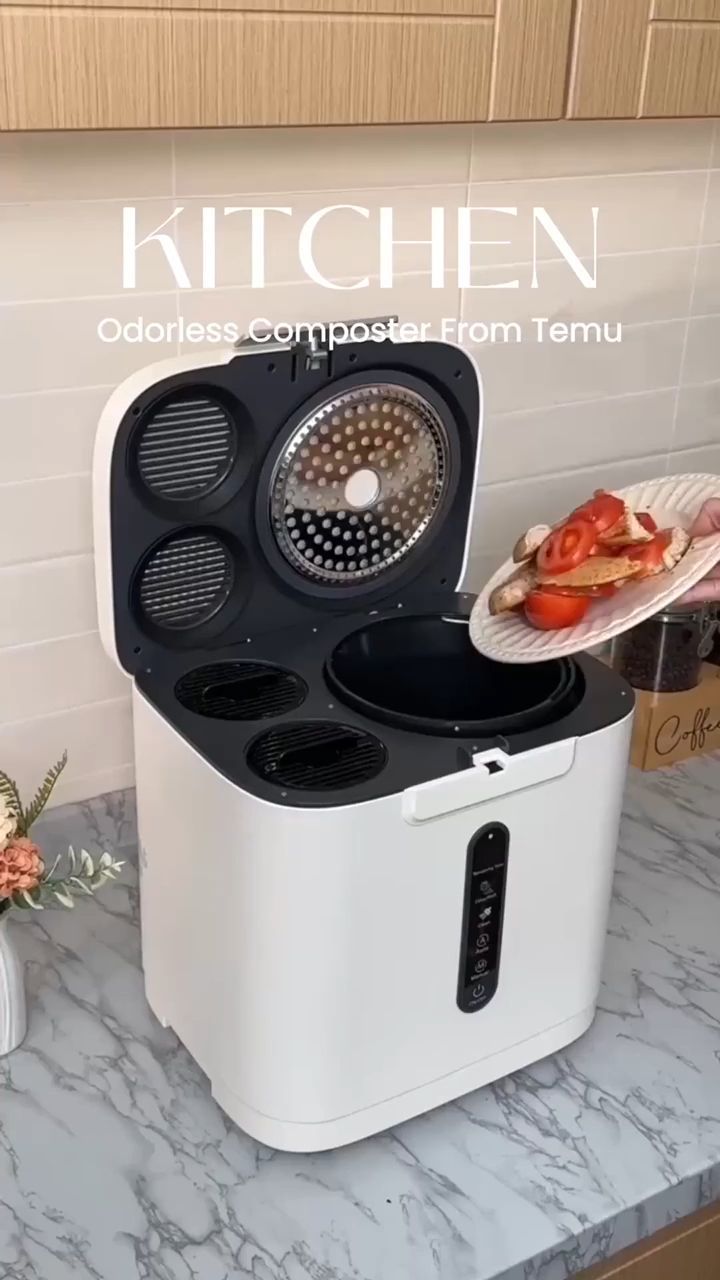
A countertop food recycler that shrinks messy kitchen scraps into dry, usable soil amendment in just a few hours
If you cook often, food waste tends to pile up fast: peels, coffee grounds, eggshells, wilted greens, and plate scraps that start smelling long before trash day. This 4L smart countertop electric kitchen composter is designed to solve that exact problem by processing organic waste right on the counter. Instead of letting scraps rot in a bin, it uses a sealed, automated cycle to dry, grind, and cool them into a much smaller, cleaner output that can later be mixed into soil.
The Standout Appeal & Why It Caught Our Attention
What makes this style of composter interesting is how it brings a normally outdoor, slow, and slightly unpleasant task into a compact indoor appliance format. The appeal is less about traditional composting and more about waste reduction with kitchen-friendly convenience. Visually, it has the look of a modern small appliance rather than a utility bin: a clean white body, rounded corners, a lift-up lid, and a slim vertical LED control strip on the front.
- Countertop-friendly format: built to live in the kitchen instead of the garage or backyard.
- Odor-focused design: dual carbon filtration helps keep the process from turning into a smell problem.
- Fast turnaround: scraps can be reduced by up to 90% in roughly 3 to 6 hours, which is dramatically quicker than natural composting.
- Cleaner end result: the output is dry and crumbly rather than wet, sticky, or decomposing.
It is also a good example of a product that is often marketed as a “composter,” even though its real innovation is rapid dehydration and grinding. That distinction matters, and it actually makes the product more understandable: this is a food waste recycler first, and a compost-prep tool second.
Key Features & How It Works
From the images and provided specs, this unit uses a fairly thoughtful internal layout. The main chamber holds a removable inner bucket, while the lid and top deck include multiple vented sections for airflow and filtration. The front panel shows a digital countdown display and touch controls for different operating modes.
- 4L capacity: sized for daily household scraps without taking over the counter.
- Heavy-duty grinding blades: positioned at the bottom of the bucket to break down dried waste into smaller particles.
- Heating and drying cycle: moisture is driven off first, which is key to reducing smell and mass.
- Cooling phase: helps finish the cycle with a safer, drier output.
- Dual-carbon filtration system: designed to trap moisture and reduce foul odors during operation.
- LED touch panel: includes Auto, Manual, and Clean functions, plus a remaining-time display.
- Auto-clean setting: useful for reducing residue buildup after repeated use.
- Dishwasher-safe removable bucket: makes emptying and cleanup much more practical than fixed-chamber designs.
- Integrated carry handle on the inner bin: easier to lift and pour the processed material.
One important technical note: the output is not finished compost in the traditional microbial sense. It is a dry organic substrate made from shredded, dehydrated food waste. For garden use, it is better treated as a pre-composted amendment that can be mixed into soil at about a 1:10 ratio so it can continue breaking down naturally.
Practical Everyday Uses
This is the kind of appliance that becomes most useful when it solves a recurring household annoyance rather than serving as a novelty.
- Apartment and condo kitchens: ideal for people who want to reduce food waste but do not have outdoor compost space. Instead of storing scraps under the sink, they can process them the same day.
- Frequent home cooks: anyone generating lots of vegetable peels, fruit skins, eggshells, and coffee grounds can keep prep waste under control without constant trash runs.
- Plant owners and small gardeners: the dry output can be added in moderation to garden beds, outdoor planters, or mixed soil systems after further natural breakdown.
It is especially useful in homes where odor is the main barrier to composting. If the alternative is a countertop scrap bowl or a smelly pedal bin, this is a much more contained system.
Things To Consider Before Buying
As clever as these machines are, they work best when buyers understand what they do well and where the limits are.
- This is an electric appliance: it needs dedicated counter space near a power outlet and enough clearance to open the lid fully.
- Cycle time varies: wetter scraps usually take longer, so expect a range of roughly 3 to 6 hours rather than a fixed result every time.
- Filter maintenance matters: carbon filters will need periodic replacement to keep odor control effective.
- Not all waste behaves the same: very oily, overly liquid, or unusually hard scraps may require more careful loading and mode selection.
- It does not create instant garden compost: the output still benefits from being mixed into soil or compost systems rather than dumped heavily into one pot.
- Noise may be low, but not zero: it is quieter than many kitchen appliances, though grinding and fan operation are still part of the process.
For the right user, this is less about replacing a backyard compost pile and more about making daily food waste management cleaner, faster, and far more realistic indoors.